


 русский
 Español
 عربى
عربى italiano
Content
- 1 The Core Advantage of Stainless Steel Hexagon Flange Nuts
- 2 Structural Design and Functional Principles
- 3 Material Grades and Corrosion Resistance
- 4 Load Distribution and Joint Integrity
- 5 Resistance to Vibration and Loosening
- 6 Installation Efficiency and Assembly Benefits
- 7 Typical Applications Across Industries
- 8 Selecting the Right Stainless Steel Hexagon Flange Nut
The Core Advantage of Stainless Steel Hexagon Flange Nuts
Stainless steel hexagon flange nuts provide a reliable, corrosion-resistant fastening solution with built-in load distribution. The integrated flange acts like a washer, spreading pressure evenly across the contact surface and reducing the risk of loosening or material damage. For structural, mechanical, and outdoor assemblies, this combination directly improves joint stability.
In practical terms, flange nuts can increase bearing surface area by 20–40% compared with standard hex nuts, depending on size. This makes them especially valuable in applications where vibration, soft materials, or repeated load cycles are present.
Structural Design and Functional Principles
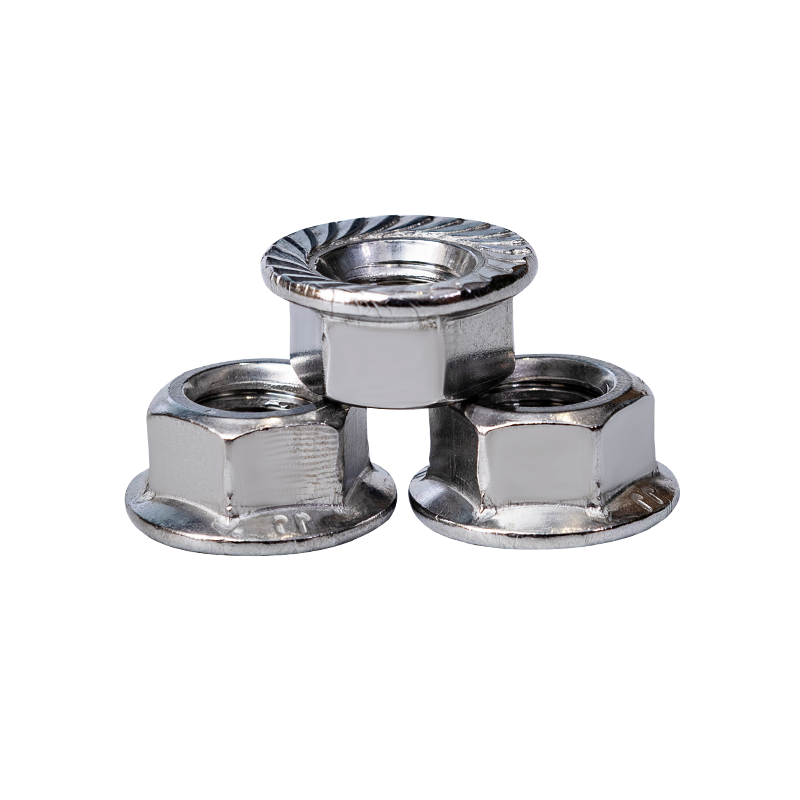
Stainless steel hexagon flange nuts are designed with a hexagonal body for standard wrench engagement and a circular flange at the base. This flange replaces the need for a separate washer while maintaining consistent clamping force.
Key design elements
- Integrated flange for pressure distribution
- Hexagonal profile for torque control
- Precision internal threading for consistent preload
Some variants include serrated flanges, which further improve resistance to vibration by increasing friction against the mating surface.
Material Grades and Corrosion Resistance
Stainless steel hexagon flange nuts are commonly manufactured from grades such as A2 (304) and A4 (316). Each grade offers distinct performance characteristics based on environmental exposure.
| Grade | Corrosion Resistance | Typical Environment |
|---|---|---|
| A2 / 304 | Good | Indoor, mild outdoor |
| A4 / 316 | Excellent | Marine, chemical |
Load Distribution and Joint Integrity
One of the primary reasons engineers specify stainless steel hexagon flange nuts is improved load distribution. The flange reduces localized stress on the joint surface, minimizing deformation in softer materials such as aluminum, plastics, or thin steel sheets.
Testing shows that flange nuts can reduce surface pressure by up to 30% compared with standard hex nuts paired with small washers. This directly extends joint life under cyclic loads.
Resistance to Vibration and Loosening
In equipment exposed to vibration, fastener loosening is a major risk. Stainless steel hexagon flange nuts address this by increasing friction at the interface and maintaining consistent clamping force.
Serrated flange designs can outperform plain nuts in vibration tests, maintaining preload after over 1 million vibration cycles in automotive and machinery simulations.
Installation Efficiency and Assembly Benefits
By eliminating the need for a separate washer, stainless steel hexagon flange nuts simplify assembly processes. Fewer components reduce handling time and inventory complexity.
In production environments, this efficiency can shorten assembly time by 10–15%, especially in high-volume manufacturing where small time savings scale quickly.
Typical Applications Across Industries
Stainless steel hexagon flange nuts are widely used across industries that demand durability and reliability. Their corrosion resistance and mechanical stability make them suitable for both indoor and outdoor use.
- Automotive assemblies and exhaust systems
- Construction and steel structures
- Marine equipment and offshore platforms
Selecting the Right Stainless Steel Hexagon Flange Nut
Choosing the correct stainless steel hexagon flange nut requires matching thread size, material grade, and flange type to the application. Over-specifying can increase cost, while under-specifying risks joint failure.
When properly selected and installed, stainless steel hexagon flange nuts deliver long-term fastening reliability with minimal maintenance, making them a practical and cost-effective choice for demanding environments.

 No. 2 Bridge, Chuangxin Road, Dainan Town, Xinghua City, Taizhou City, Jiangsu Province
  +86-17315333748(Wechat)
 +86-17315333748(Wechat/Whatsapp)

