


 русский
 Español
 عربى
عربى italiano
Content
What Sets 304 Stainless Steel Bolts Apart
A bolt stamped "A2-70" or "18-8" on its head is telling you exactly what alloy family it belongs to: 304-grade austenitic stainless steel. This composition runs roughly 18% chromium and 8% nickel, and that ratio is what gives SS304 bolts their signature combination of corrosion resistance, non-magnetic behavior, and formability without becoming brittle.
Unlike carbon steel fasteners that rely on a zinc or cadmium coating for protection, 304 stainless forms a passive chromium-oxide layer on its own surface. Scratch it, and the layer reheals in the presence of oxygen. That self-repairing property is why SS304 bolts hold up in humid, wet, or mildly corrosive settings where plated fasteners eventually rust from the inside out once the coating is breached.
The tradeoff is cost and, in certain aggressive environments, a ceiling on chemical resistance that pushes some buyers toward 316-grade instead — a comparison worth walking through before placing a bulk order.
Mechanical Performance and Corrosion Resistance
304 stainless steel bolts typically deliver a minimum tensile strength around 515 MPa and a yield strength near 205 MPa, figures that place them below high-strength alloy steel grades like 10.9 but well ahead of standard zinc-plated commercial bolts in long-term reliability. Their real advantage shows up over years of service, not on a single load test.
Corrosion resistance holds up well against fresh water, mild acids, and most atmospheric exposure. Where SS304 falls short is sustained contact with chlorides — coastal air, de-icing salts, or marine spray can eventually cause pitting or crevice corrosion, particularly at the shank-to-nut interface where moisture gets trapped. For those conditions, upgrading to 316 stainless, which adds molybdenum for chloride resistance, is usually the more durable choice.
304 bolts also perform reliably at elevated temperatures up to roughly 870°C for short-term exposure, though continuous high-heat service calls for checking the specific grade variant (304 vs 304L vs 304H) against the application's thermal cycle.
Common SS304 Bolt Types and When to Use Them
Bolt geometry matters as much as material grade once you're matching a fastener to a joint. Hexagon head bolts across common DIN and GB standard sizes remain the default choice for structural and general assembly work, since a standard wrench or socket handles installation and the head sits proud enough for high-torque tightening. A typical spec sheet, such as the one for an SS304 DIN933 M10 hexagon head bolt, will list thread diameter, length range, and marking so the part can be cross-checked against a drawing before ordering.
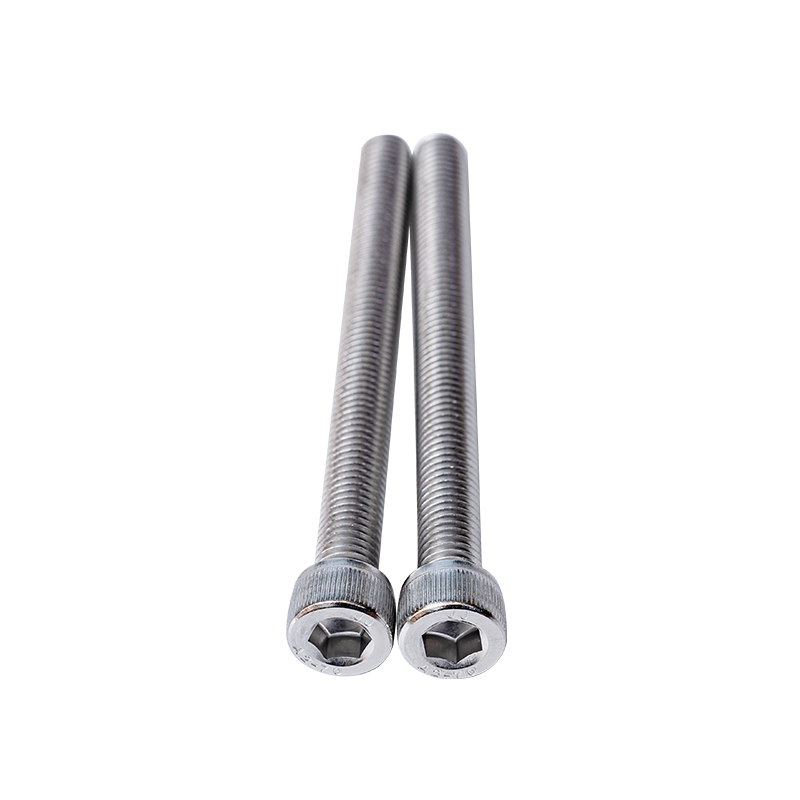
Where clearance is tight or a cleaner finished look is required, socket head allen bolts take over. Their internal hex drive lets the fastener sit flush or recessed, which is common in machinery panels, enclosures, and architectural steelwork. An SS304 DIN912 M10 allen bolt follows the same metric sizing logic as a hex head equivalent, just with a different drive style and typically a higher clamping torque for a given diameter.
Cup head square neck bolts and pan head socket bolts round out most catalogs, serving niche cases like timber-to-metal connections or low-profile electronics assembly, respectively. Matching the head style to the access constraints of the joint avoids costly rework later.
SS304 vs SS316: Choosing the Right Grade
Both grades share the same austenitic base and similar mechanical ratings, so the decision usually comes down to environment and budget rather than strength.
| Factor | SS304 | SS316 |
|---|---|---|
| Chloride/saltwater resistance | Moderate | High (molybdenum-alloyed) |
| Typical cost | Lower | 15–30% higher |
| Common use case | Indoor, general industrial, dry-to-moderate outdoor | Marine, coastal, chemical processing |
| Magnetic response | Non-magnetic (may show slight magnetism after cold working) | Non-magnetic |
As a rule of thumb, if the fastener will see direct saltwater spray, de-icing chemicals, or a chloride-heavy processing environment, the extra cost of 316 pays for itself in avoided replacement labor. For dry or occasionally wet indoor use, 304 is the more economical and equally durable option.
Matching Nuts, Washers, and Assembly Considerations
A bolt is only half of a reliable joint. Pairing an SS304 bolt with a matching SS304 hex nut in the same diameter and thread pitch keeps galvanic behavior consistent across the joint and avoids the seizing that can happen when dissimilar stainless grades are torqued together over time.
Washers do more than distribute load. A flat washer sized to the bolt diameter protects softer base materials from surface marring during tightening and helps spread clamping pressure evenly, which matters on thin sheet metal or coated panels where a bare nut face could gouge the finish.
On assemblies exposed to vibration, an additional spring or lock washer is worth specifying, since stainless-on-stainless threads have a lower natural friction coefficient than plated carbon steel and can back out under repeated cyclic loading without it.
Standards and Specifications to Check Before Ordering
Most SS304 bolts on the market are produced to one of a handful of dimensional standards — DIN933 and DIN912 in metric markets, or their GB equivalents for China-sourced fasteners. These define thread pitch, head dimensions, and tolerances, but not material composition on their own.
For material and mechanical property verification, ASTM F593 covers the chemical and mechanical requirements for stainless steel bolts across seven alloy groups, including 304 and 316. Requesting mill test certificates referencing this specification is standard practice for procurement teams sourcing fasteners for regulated or safety-critical applications.
Buyers evaluating hex bolts specifically may also want a full breakdown of stainless steel hex bolt properties, applications, and selection criteria before finalizing a spec sheet, since head style and grade decisions are easier to make together than in isolation.

 No. 2 Bridge, Chuangxin Road, Dainan Town, Xinghua City, Taizhou City, Jiangsu Province
  +86-17315333748(Wechat)
 +86-17315333748(Wechat/Whatsapp)

