


 русский
 Español
 عربى
عربى italiano
On a solar farm, the maintenance records told a familiar story. White, chalky deposits were spreading around stainless steel bolts on aluminium mounting rails, and pitting had begun beneath each bolt head. This is the aluminium and stainless steel reaction in practice, and it is one of the most common causes of premature failure in mixed-metal assemblies. The reaction does not mean the two metals can never be used together. It means the joint must be designed with a clear understanding of galvanic corrosion, which is exactly what this article provides.
Content
- 1 What the Aluminium and Stainless Steel Reaction Actually Is
- 2 The Three Conditions That Must Be Present
- 3 Why Aluminium Is Always the Sacrificial Metal
- 4 When Aluminium and Stainless Steel Can Be Used Together Safely
- 5 How to Prevent Galvanic Corrosion in Mixed-Metal Assemblies
- 6 Selecting the Right Stainless Steel Fastener Grade
- 7 Practical Assembly Guidelines
What the Aluminium and Stainless Steel Reaction Actually Is
The aluminium and stainless steel reaction is a form of galvanic corrosion, also called bimetallic corrosion. When the two metals are in electrical contact and both are exposed to an electrolyte, whether sea spray, rainwater, condensation, or simply persistent humidity, they form a galvanic couple. Aluminium, the less noble metal, becomes the anode and begins releasing metal ions. Stainless steel, the more noble metal, becomes the cathode. Electrons travel from the anode to the cathode through the metallic connection, and the electrolyte completes the electrical circuit. The result is that aluminium corrodes far faster than it would on its own.
This is not a chemical attack by stainless steel on aluminium. The stainless steel simply acts as a large, efficient cathode that accelerates the natural corrosion of the aluminium. The visible signs are distinctive: white or grey corrosion products on the aluminium surface, pitting around the fastener head or washer, and, in severe cases, a gradual loss of clamping force as the aluminium loses thickness.
The Three Conditions That Must Be Present
Galvanic corrosion is not automatic. It requires three simultaneous conditions, and removing any one of them stops the reaction.
- Electrical contact. The two metals must be connected through a conductive path. A stainless steel bolt driven into an aluminium rail, or an aluminium bracket clamped by a stainless steel nut, provides exactly that path.
- An electrolyte. A conductive fluid must bridge the two surfaces. Saltwater is the most aggressive electrolyte, but rainwater, condensation, and even moisture absorbed under a coating can drive the reaction at a meaningful rate.
- A difference in electrochemical potential. The metals must differ in their tendency to corrode. Aluminium and stainless steel differ by roughly half a volt in seawater, which is more than enough to sustain significant corrosion.
The practical consequence is straightforward: keep the metals dry, keep them electrically separated, or accept that the aluminium will corrode. Every effective prevention method attacks one of these three conditions.
Why Aluminium Is Always the Sacrificial Metal
Every metal has a position on the galvanic series, which ranks materials by their corrosion potential in a given environment. In seawater, stainless steel sits well above aluminium. That means stainless steel is the cathode and aluminium is the anode whenever the two are connected in a wet assembly.
| Metal | Position in Seawater | Behaviour in an Aluminium-Steel Couple |
|---|---|---|
| Aluminium alloys | Active (anodic) | Corrodes; becomes the sacrificial metal |
| 304 stainless steel | Noble (cathodic) | Protected; no meaningful mass loss |
| 316 stainless steel | Noble (cathodic) | Protected; no meaningful mass loss |
One nuance is worth knowing. Stainless steel is only noble while its passive oxide layer is intact. Inside an oxygen-poor crevice, such as the gap beneath a bolt head or between tightly clamped surfaces, stainless steel can lose its passive layer and become active. That is why crevice corrosion appears on stainless fasteners even without aluminium present. In a weather-exposed aluminium-steel couple, however, the practical outcome is consistent: aluminium is the metal that loses material.
When Aluminium and Stainless Steel Can Be Used Together Safely
The aluminium and stainless steel reaction is not inevitable. Countless mixed-metal assemblies have given long service lives because the conditions for galvanic corrosion were never met.
- Indoor, dry environments. A heated, ventilated interior rarely provides enough electrolyte to sustain galvanic corrosion, so the couple may remain inactive for decades.
- Sealed joints. If the interface is coated with a compatible sealant, or separated by a moisture-excluding barrier, the electrolyte cannot reach the junction and the circuit stays open.
- A favourable area ratio. When the aluminium part is large and the stainless steel part is small, the galvanic current spreads over a wide aluminium surface, so the local corrosion rate can be acceptable for the intended design life. The dangerous case is the opposite: a small aluminium component attached to a large stainless steel structure concentrates all the corrosion on a small anode and fails quickly.
For outdoor or marine service, the conservative assumption is that moisture will eventually be present. In solar racking, architectural cladding, boat hardware, and industrial equipment exposed to the weather, prevention is a design requirement rather than an option.
How to Prevent Galvanic Corrosion in Mixed-Metal Assemblies
The most reliable way to stop galvanic corrosion is to interrupt the electrical circuit between the two metals, or to keep the electrolyte away from the junction. Several measures work well in combination.
- Isolate with non-conductive barriers. A nylon or fibre washer under the stainless steel fastener head, combined with an isolating sleeve over the bolt shank, prevents direct metal-to-metal contact. This is the single most effective method.
- Seal the joint. A polysulphide, polyurethane, or butyl sealant applied around the fastener head and along the joint edge excludes moisture and physically separates the surfaces.
- Use coatings with caution. Powder-coating or painting the aluminium before assembly adds a barrier, but any scratch or chip can create a local anode. Coatings should never be the only line of defence.
- Design for drainage. Position the joint so that water drains away from the fastener instead of pooling around it.
A stainless steel flat washer has a double role in this system. It spreads the clamping load over a wider area, which matters on soft aluminium, and it provides a smooth bearing surface for the nut or bolt head. It does not, by itself, stop galvanic corrosion unless it is separated from the aluminium by an isolating layer. When paired with a nylon washer or a sealant bead, a 304 stainless steel flat washer gives a long service life and consistent clamping performance.
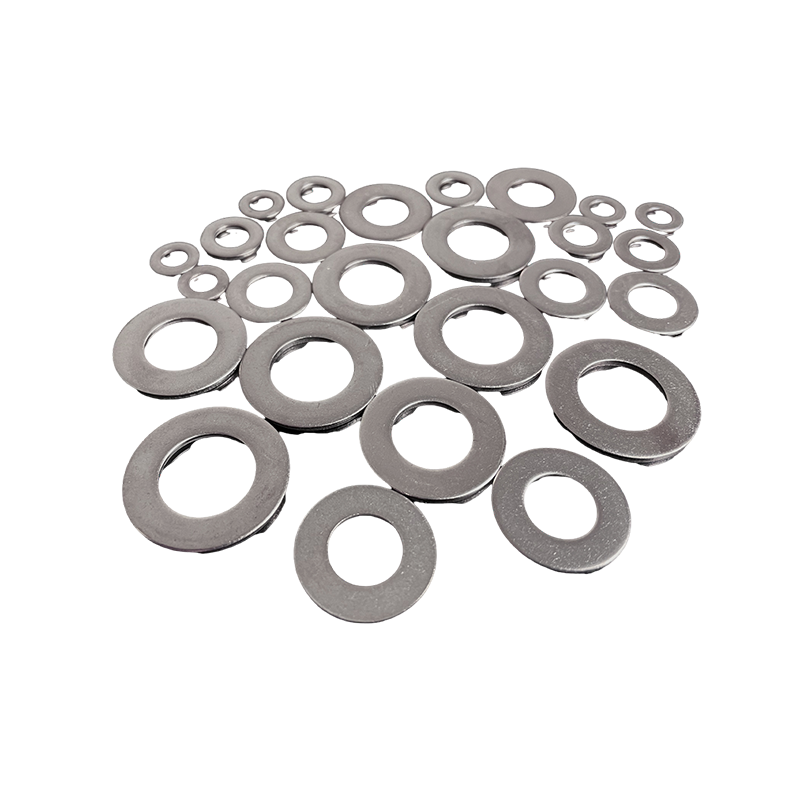 SS304 Flat Washer for M10 Bolts, DIN125/GB97This 304 stainless steel flat washer spreads clamping loads on soft aluminium and provides a smooth bearing surface, though galvanic isolation still requires a separating layer.View Product →
Selecting the Right Stainless Steel Fastener Grade
If the design requires stainless steel fasteners in contact with aluminium, the two standard choices are 304 (A2) and 316 (A4) stainless steel. Both are austenitic grades with far better corrosion resistance than carbon steel, and both sit at similar positions on the galvanic series. The selection does not change the galvanic behaviour of the couple. Neither grade is meaningfully better than the other at protecting the aluminium, so the decision is really about how well the fastener itself survives in the service environment.
304 stainless steel is the default for most industrial and architectural work. It resists atmospheric corrosion, fresh water, and a wide range of chemicals. For an inland solar array or a building facade, a stainless steel fastener in grade 304 is a proven and cost-effective choice. Both 304 and 316 are produced to DIN 933, GB5783, and ISO 4017 standards, and our guide to 304 versus 316 stainless steel hex bolts compares the two grades in more detail.
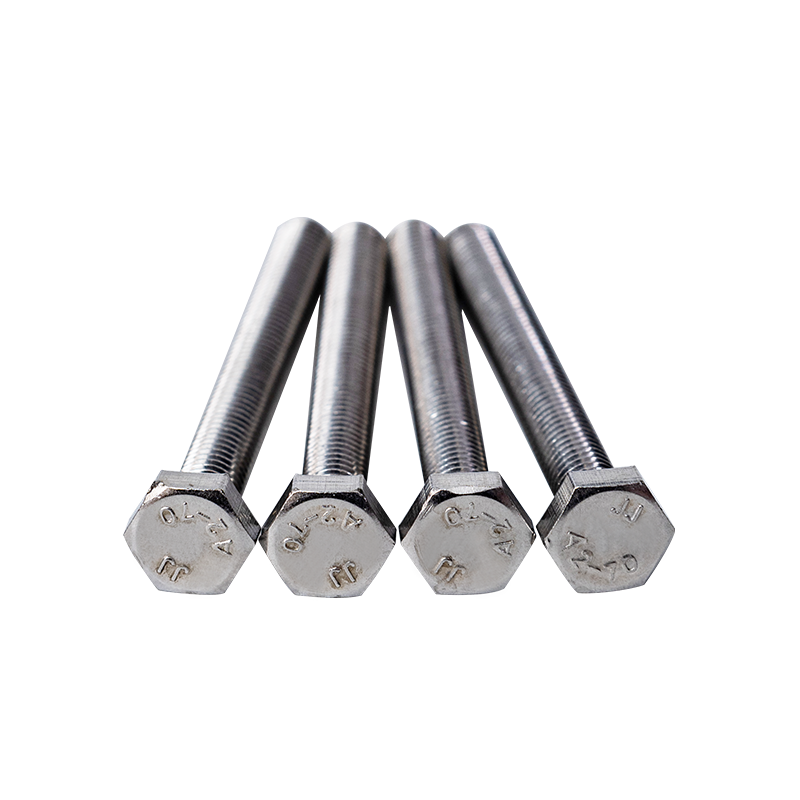 SS304 M10 Hexagon Head Bolt, DIN933 StandardA proven, cost-effective 304 stainless steel bolt for inland or general environments, offering atmospheric corrosion resistance and reliable load-bearing performance for structural connections.View Product →
316 stainless steel adds molybdenum, which improves resistance to chlorides. Coastal installations, boat hardware, and any environment exposed to road salt should use 316 for the fasteners, because the fastener must outlast the assembly in the most demanding conditions. As a general rule, the stainless steel fastener range for mixed-metal projects should be selected on the basis of chloride exposure, not on the assumption that a different grade will somehow protect the aluminium.
| Service Environment | Recommended Grade | Basis for Choice |
|---|---|---|
| Dry, indoor assembly | 304 (A2) | Low galvanic risk; electrolyte rarely present |
| General outdoor, inland | 304 (A2) | Rain and humidity are manageable with isolation |
| Coastal or marine | 316 (A4) | Chloride resistance protects threads and heads |
| De-icing salt exposure | 316 (A4) | Salt is the dominant threat; 316 is the safer choice |
For a coastal installation, pairing a 316 hex nut with a 316 bolt is the most reliable option, particularly for threaded connections that will be inspected over time. The corrosion resistance difference between 304 and 316 in a marine atmosphere is significant enough to justify the higher cost of 316.
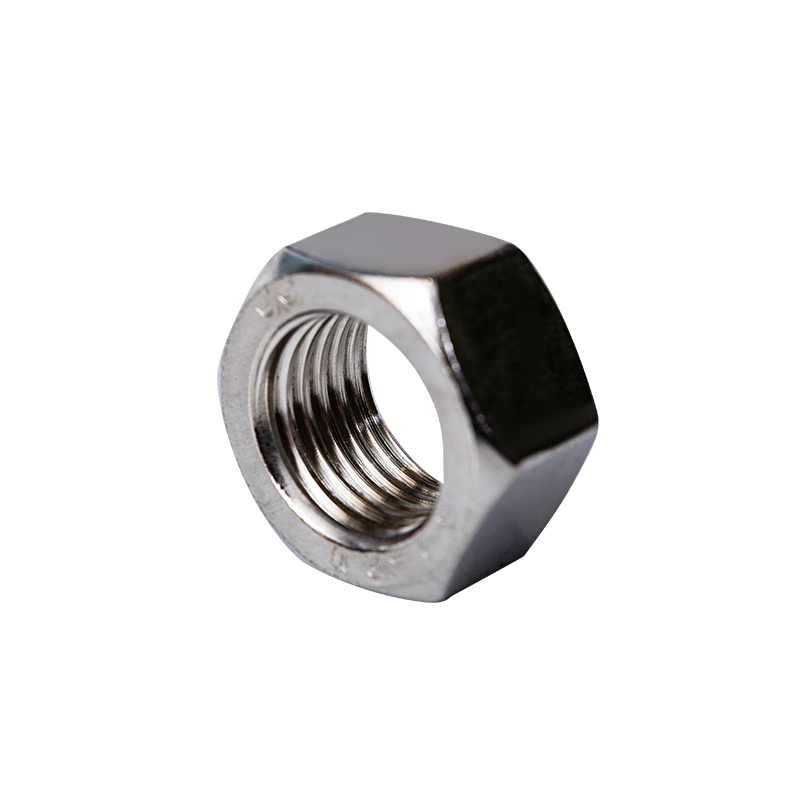 SS316 M10 Hex Nut, DIN934 StandardA 316 stainless steel hex nut with A4-80 grade, designed for marine and chloride-rich environments, providing secure clamping and long-term corrosion resistance when paired with 316 bolts.View Product →
Practical Assembly Guidelines
Mixed-metal assemblies fail when the basics are skipped. The following sequence has proven effective for solar mounting, marine deck hardware, industrial frames, and architectural aluminium structures.
- Clean both faying surfaces before assembly. Grease, grit, or conductive contamination can create a corrosion cell even when the design is correct.
- Install the isolating layer first. Place a nylon washer or a sealant bead under the stainless steel fastener head and on the bearing face of the nut.
- Tighten to the rated torque. Over-torquing crushes the isolating layer, distorts the aluminium, and leaves the joint vulnerable to both galvanic corrosion and stress relaxation.
- Inspect after the first season of exposure. Early corrosion appears as white powder or faint pitting. If caught then, the fix is a replacement washer and a dab of sealant, not a structural repair.
None of this should discourage engineers and fabricators from using aluminium and stainless steel together. The two materials perform well as a system when the rules above are followed. The aluminium corrodes only if the galvanic circuit remains complete, and that circuit is easy to interrupt.

 No. 2 Bridge, Chuangxin Road, Dainan Town, Xinghua City, Taizhou City, Jiangsu Province
  +86-17315333748(Wechat)
 +86-17315333748(Wechat/Whatsapp)

