


 русский
 Español
 عربى
عربى italiano
A maintenance supervisor at a coastal solar farm notices white, powdery corrosion forming around stainless steel bolts on aluminum mounting rails. Within months, the aluminum around the bolt holes begins to pit. The bolts look fine, but the structure is being eaten away from the contact region. This is galvanic corrosion between aluminum and stainless steel, and it is one of the most common mixed-metal fastening failures in the field.
The short answer is that stainless steel fasteners can be used on aluminum structures, but only when the joint is designed with the galvanic couple in mind. Without proper isolation, the aluminum will corrode preferentially because it sits lower on the galvanic series than stainless steel. Understanding why this happens and how to control it determines whether an assembly lasts ten years or fails in ten months.
Content
What Is Galvanic Corrosion?
Galvanic corrosion, also called bimetallic corrosion, occurs when two dissimilar metals are in electrical contact with each other and both are exposed to an electrolyte. The more active metal becomes the anode and corrodes faster than it would alone; the more noble metal becomes the cathode and receives protection.
The galvanic series ranks metals and alloys by their corrosion potential in a given environment. Stainless steels sit near the noble end of the scale, while aluminum sits significantly lower. The farther apart two metals are on that scale, the stronger the driving voltage for corrosion.
In an aluminum-and-stainless-steel joint, the aluminum acts as the anode. Electrons flow from the aluminum to the stainless steel through the metallic contact path, while ionic current completes the circuit through the electrolyte film on the surface. The aluminum dissolves at anodic sites, producing the white, chalky aluminum hydroxide deposits that field engineers quickly learn to recognize.
What surprises many engineers is that the stainless steel itself remains virtually untouched. The damage is all on the aluminum side of the couple. That makes the problem insidious: the fasteners still look new while the structure quietly deteriorates around them.
Why Aluminum and Stainless Steel Need Careful Handling
The passive chromium oxide layer on stainless steel is the main reason the alloy behaves so nobly. This invisible film is self-healing and highly resistant to chloride attack, especially in grades such as 304 and 316. Aluminum also carries a protective oxide layer, but that film is less stable in the presence of chlorides and is easily damaged by abrasion, tooling, or pH extremes.
Three factors determine how severe the galvanic attack will be on an aluminum-stainless steel assembly:
- Potential difference. For aluminum against stainless steel, the open-circuit potential difference in seawater typically falls between 0.5 and 0.7 volts, which is enough to drive significant current.
- Electrical continuity. Direct metal-to-metal contact gives electrons a low-resistance path from the anode to the cathode.
- Cathode-to-anode area ratio. This is the factor that catches most designers off guard. A large stainless steel surface connected to a small aluminum area produces rapid, concentrated corrosion. A large aluminum surface with a small stainless steel fastener, by contrast, corrodes much more slowly because the anode current density is spread across a wide area.
The area-ratio principle explains why the zone immediately under and around the fastener head is usually the first area to show pitting. It also explains why a massive stainless steel bracket bolted to a thin aluminum panel is a far more dangerous combination than a small stainless steel bolt passed through a large aluminum frame.
Conditions That Accelerate the Attack
Not every aluminum-stainless steel assembly fails. Many dry, indoor installations run for decades with no visible galvanic damage. The corrosion rate depends heavily on the environment and on joint geometry.
| Factor | Effect on Galvanic Corrosion |
|---|---|
| Moisture or electrolyte | Required for ionic transport; continuous wetting accelerates attack |
| Chloride concentration | Salt air, de-icing salts, and marine water break down protective oxide films |
| Temperature | Higher temperatures increase reaction kinetics and corrosion current |
| Cathode-to-anode area ratio | A larger cathode surface drives faster dissolution of the anode |
| Coating condition | Damaged paint or anodizing creates small active anode sites |
| Galvanic contact | Direct metal-to-metal contact at threads and bolt heads is the main current path |
The most dangerous service environment combines persistent moisture with chlorides: coastal outdoor structures, swimming-pool frameworks, marine deck hardware, and road-exposed components. Indoor, climate-controlled environments rarely supply enough electrolyte to sustain significant galvanic current, which is why mixed-metal fasteners are widely used inside buildings without incident.
How to Prevent Galvanic Corrosion Between Aluminum and Stainless Steel
The engineering principle is straightforward: either break the electrical continuity between the two metals, or prevent the electrolyte from bridging them.
Separate the Metals with a Barrier
Place a non-conductive material between the aluminum surface and the stainless steel fastener. Nylon washers, plastic gaskets, and insulating sleeves that cover the bolt shank are all effective. The barrier must extend across the full contact zone, including the area under the bolt head and the face of the nut.
A stainless steel flat washer does not isolate the two metals, but it still has an important protective job. It distributes clamping pressure evenly and prevents the bolt head or nut from cutting through the aluminum oxide layer. A damaged oxide layer creates a small active anode site that intensifies localized attack, so a correctly sized flat washer under both the head and the nut preserves the integrity of the aluminum surface and lowers the risk of crevice corrosion.
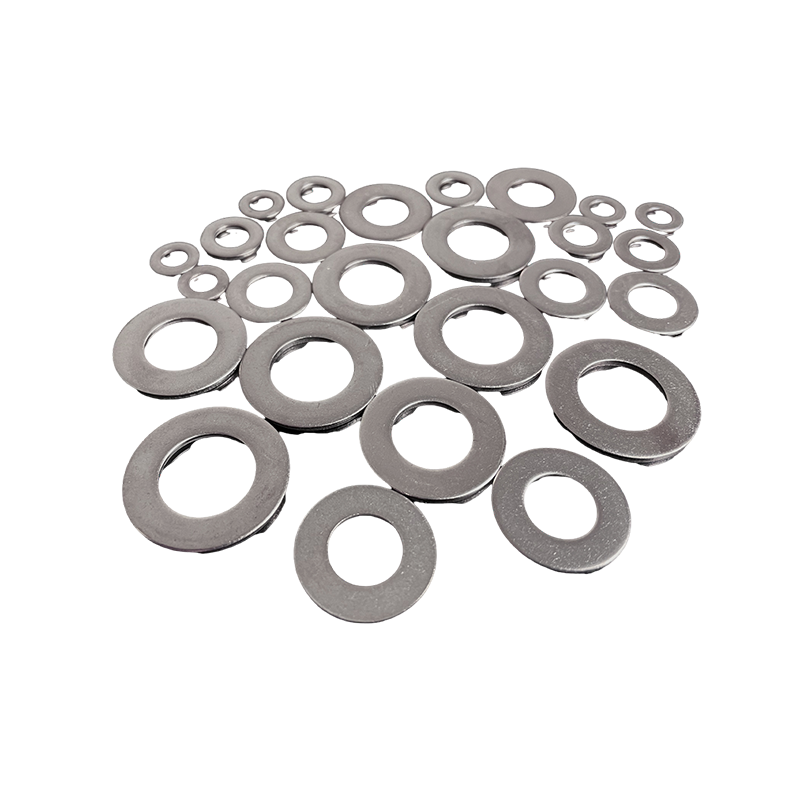 SS304 DIN125/GB97 M10 Flat Washers for Aluminum AssembliesThese precision 304 stainless steel flat washers, sized for M10 fasteners, distribute clamp load evenly and protect the aluminum oxide layer. Ideal for reducing crevice corrosion risk in existing assemblies.View Product →
Seal the Joint
Apply a sealant or mastic around the fastener hole to exclude moisture. If no electrolyte reaches the junction, the galvanic cell cannot operate. This is often the most practical retrofit for existing assemblies, but the sealant must be inspected periodically because it degrades under UV exposure and mechanical flexing.
Minimize the Cathode Area
Keep the stainless steel surface small relative to the aluminum anode. Avoid clustering large stainless steel plates, brackets, or multiple fasteners in a confined region, because each additional cathode surface increases the demand on the aluminum.
Design for Drainage
Eliminate water traps at fastening points. Horizontal surfaces where water pools against a fastener are high-risk locations. Tilt the joint or add drainage channels so that moisture cannot sit against the fastener and the surrounding aluminum.
Selecting Stainless Steel Fasteners for Aluminum Assemblies
When the decision comes down to a stainless steel bolt on an aluminum structure, the grade, standard, and fastener geometry are just as important as the installation details.
For general-purpose aluminum framing in sheltered or indoor environments, SS304 hex bolts supplied to DIN933 or GB5783 are a proven and economical choice. They provide dependable corrosion resistance where chlorides are not a major factor, and their mechanical properties are well matched to standard aluminum extrusions.
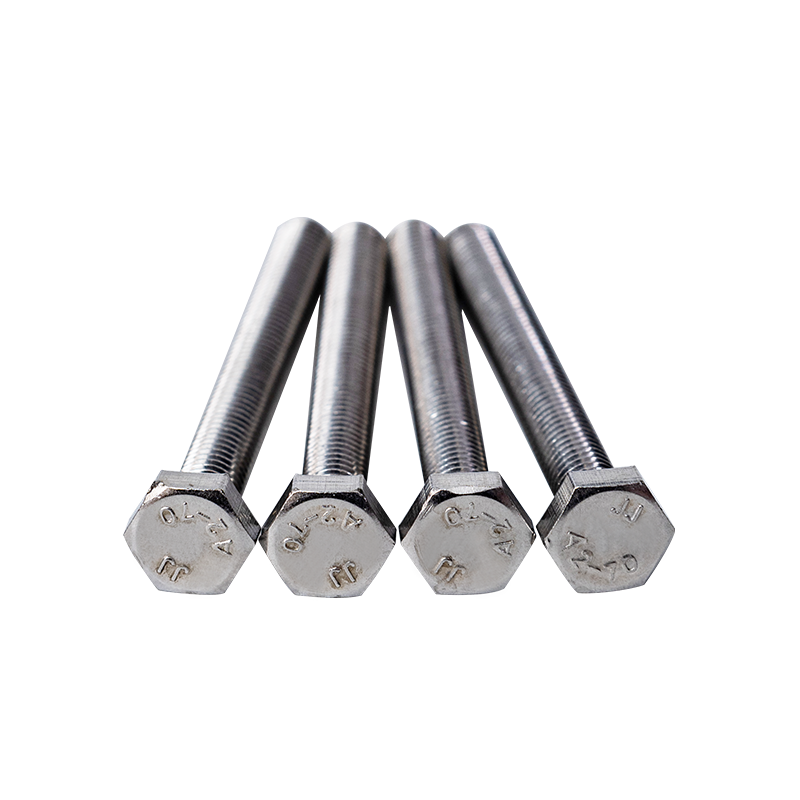 SS304 DIN933 M10 Hexagon Head Bolts for General Indoor UseA practical choice for sheltered aluminum framing, these A2-70 stainless steel hex bolts offer reliable corrosion resistance and strong load capacity without the higher cost of 316 stainless steel.View Product →
For coastal, marine, or chemical-process exposure, SS316 hex bolts are the safer specification. The 2 to 3 percent molybdenum addition improves pitting resistance in chloride environments, which directly reduces the risk of localized attack at the fastener-to-aluminum interface. The higher material cost is trivial compared with the cost of cutting out and replacing corroded aluminum sections in the field. Our comparison of 304 versus 316 stainless steel hex bolts explains the performance gap in practical terms.
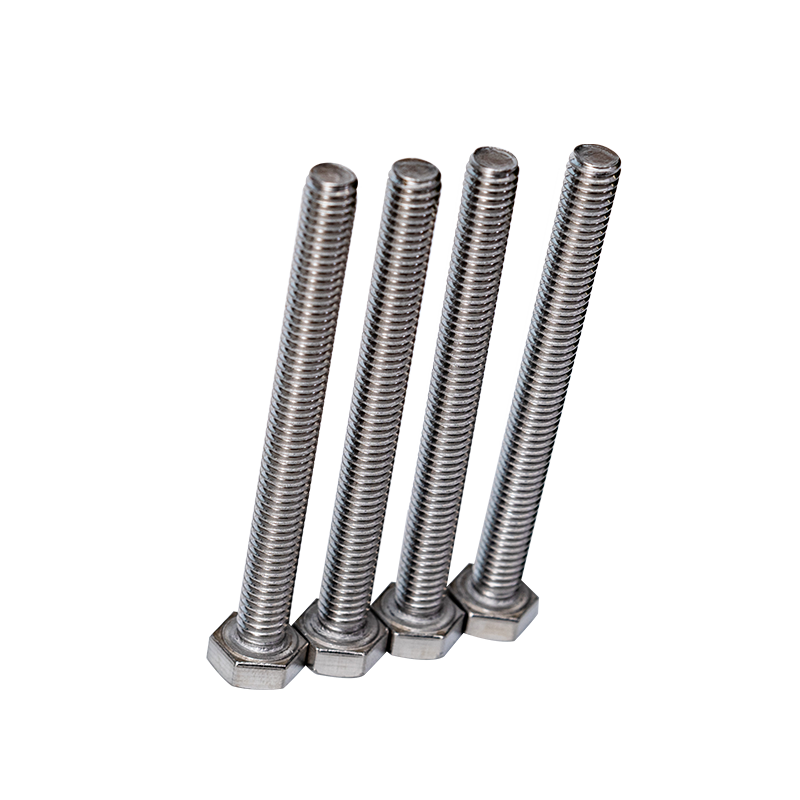 SS316 DIN933 M10 Hexagon Head Bolts for Marine EnvironmentsMade from A4-80 stainless steel with molybdenum, these hex bolts provide superior pitting resistance in chloride-rich coastal or chemical-process settings, reducing localized corrosion at fastener threads.View Product →
Buyers also overlook the threaded portion of the fastener. The thread root is a crevice by nature, and it traps moisture against the aluminum surface. In a marine atmosphere, a 304 bolt can develop shallow pitting and rust-like discoloration from embedded iron particles, while 316 typically stays clean. That difference matters most when the fastener threads pass directly through a hole in the aluminum member.
Procurement and Specification Advice
When ordering stainless steel fasteners for aluminum structures, specify the standard, material grade, and surface condition explicitly. DIN933 for hex bolts, DIN934 for hex nuts, and DIN125 for flat washers are recognized across international projects. Ask the supplier for material test certificates covering chemical composition and, where required, mechanical properties.
Pay attention to surface finish. Pickled and passivated stainless steel resists corrosion far better than as-rolled or improperly cleaned stock. Inexpensive fasteners that are sold as stainless are sometimes made from low-grade steel with a thin chromium layer; passivation testing or a simple magnet check can screen out the worst of these.
For larger projects, work with a manufacturer that can supply bolts, nuts, washers, and threaded rods from one production line with consistent grade traceability. A reliable supplier will also recommend the correct washer sizes, thread lengths, and torque values, all of which affect the long-term performance of an aluminum bolted joint. The complete fastener catalog covers hex bolts, nuts, washers, threaded rods, and other stainless steel fasteners with full dimensional data.

 No. 2 Bridge, Chuangxin Road, Dainan Town, Xinghua City, Taizhou City, Jiangsu Province
  +86-17315333748(Wechat)
 +86-17315333748(Wechat/Whatsapp)

