


 русский
 Español
 عربى
عربى italiano
A replacement M10 hex bolt sits on the bench, and the nut that came off it has rolled somewhere under the rack. You pull up a bolt and nut size chart, scan down the column, and see "M10 x 1.5." The question is whether an M10 nut is automatically the right match, or whether the chart is telling you something more specific. In practice, the nut and bolt have to agree on two values, not one: the nominal diameter and the thread pitch. This guide shows how to read a bolt and nut size chart for metric stainless steel fasteners, what the numbers mean on the shop floor, and where buyers most often misread the table.
Content
- 1 What a Bolt and Nut Size Chart Actually Tells You
- 2 Metric vs Imperial: Two Systems on the Same Chart
- 3 Reading Bolt Dimensions on a Size Chart
- 4 Reading Nut Dimensions on a Size Chart
- 5 How to Match Bolts and Nuts Correctly
- 6 Material and Standard Notes That Change How You Read the Chart
- 7 Procurement Tips for Working with a Bolt and Nut Size Chart
- 8 The Practical Takeaway
What a Bolt and Nut Size Chart Actually Tells You
A size chart for bolting is not a list of measured part widths. It is a pairing table. Each row defines the nominal diameter of the thread, the standard pitch for that diameter, and the width across flats that determines which wrench fits. When the chart says M10, it means the outer thread diameter of the bolt and the matching inner thread diameter range of the nut are both built around a 10 mm nominal size.
Two rows are normally given for the same diameter. Coarse pitch is the default for most general-purpose stainless steel bolting. Fine pitch is used where vibration resistance, thinner wall thickness, or precise adjustment matters. The bolt and nut size chart only works when both parts use the same pitch. A coarse-pitch M12 nut will start on a fine-pitch M12 bolt and then jam after one or two turns.
Metric vs Imperial: Two Systems on the Same Chart
The first thing to check before reading any size chart is which system it uses. Metric sizes are written as M followed by a number, for example M6, M10, or M24, with pitch in millimetres. Imperial sizes are written as a fraction, for example 1/4-20, where 1/4 is the nominal diameter in inches and 20 is the number of threads per inch.
Manufacturers that work to DIN, ISO, and GB standards publish metric charts, while suppliers oriented to the North American market usually publish inch charts. Mixing the two is one of the most common purchasing errors. A 10 mm bolt is not the same as a 3/8-inch bolt, even though both are close to 10 mm in diameter, and their threads are not interchangeable. If your assembly was built to metric drawings, stay on the metric side of the chart.
Reading Bolt Dimensions on a Size Chart
For a metric hex bolt, the chart lists four values that matter: nominal diameter, thread pitch, length, and width across flats. Nominal diameter is the size of the bolt. Pitch is the distance between thread crests. Length is measured from the underside of the head to the end of the shank. Width across flats is the distance between two opposite flats of the hex head, which is the wrench size.
| Bolt size (M) | Thread pitch (mm) | Width across flats (mm) | Typical length range (mm) |
|---|---|---|---|
| M5 | 0.8 | 8 | 10-50 |
| M6 | 1.0 | 10 | 12-60 |
| M8 | 1.25 | 13 | 16-80 |
| M10 | 1.5 | 16 | 20-100 |
| M12 | 1.75 | 18 | 25-120 |
| M16 | 2.0 | 24 | 30-160 |
| M20 | 2.5 | 30 | 40-200 |
| M24 | 3.0 | 36 | 50-240 |
| M30 | 3.5 | 46 | 60-300 |
When you see "M10 x 1.5" on a DIN 933 hex bolt, the M10 is the nominal diameter, and 1.5 is the coarse pitch for that size. The 16 mm width across flats tells the mechanic which spanner to grab. On the shop floor, wrench size is often the only value from the chart that gets checked visually, but it is the pitch that decides whether the nut will run freely.
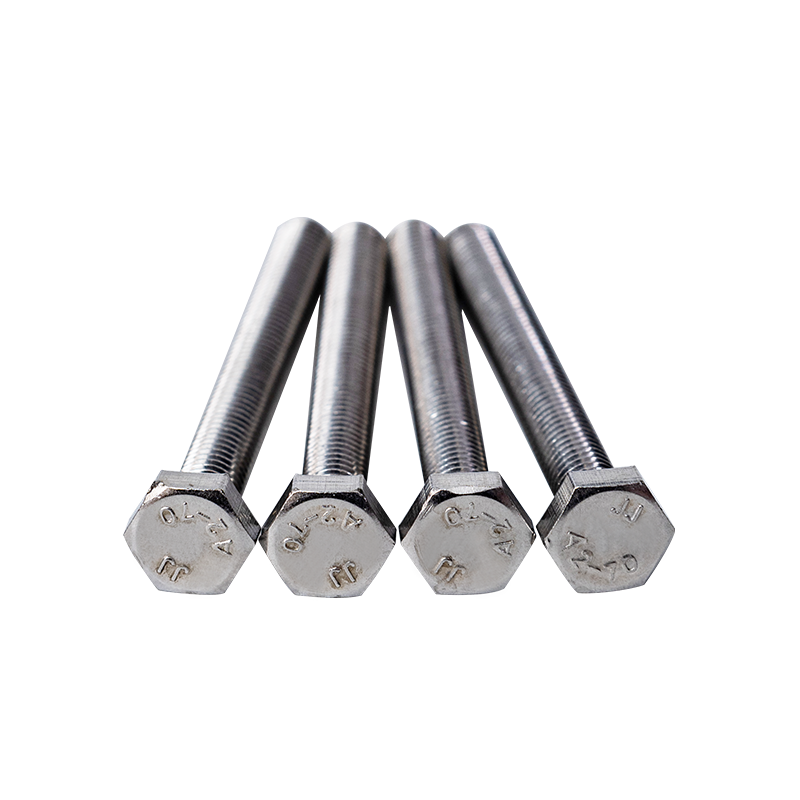 SS304 DIN933 M10 Hexagon Head Bolts for Structural FasteningThis M10 hex bolt matches the DIN 933 standard with a 16 mm across-flats size. It suits heavy-duty construction and machinery tasks, and the page details its A2-70 stainless steel composition and corrosion resistance for wet environments.View Product →
Reading Nut Dimensions on a Size Chart
The most frequent misunderstanding in a nut size chart is that the "size" of the nut is its own outer width. It is not. A chart lists a nut by the bolt diameter it fits: an M10 hex nut fits an M10 bolt. The outer width of that nut, measured across the flats, is 16 mm for the standard hex nut. That is how the nut gets referenced against the bolt and the wrench at the same time.
| Nut size (M) | Width across flats (mm) | Nut thickness (mm) |
|---|---|---|
| M5 | 8 | 4 |
| M6 | 10 | 5 |
| M8 | 13 | 6.5 |
| M10 | 16 | 8 |
| M12 | 18 | 10 |
| M16 | 24 | 13 |
| M20 | 30 | 16 |
| M24 | 36 | 19 |
| M30 | 46 | 24 |
A hex nut from the DIN 934 series uses the same width across flats as a DIN 933 hex bolt of the same M size. That is why the same spanner fits both. The thickness column shows how much thread engagement the nut gives; for stainless steels such as 304 and 316, the standard height is enough for the connection to develop full tensile strength in most bolted joints.
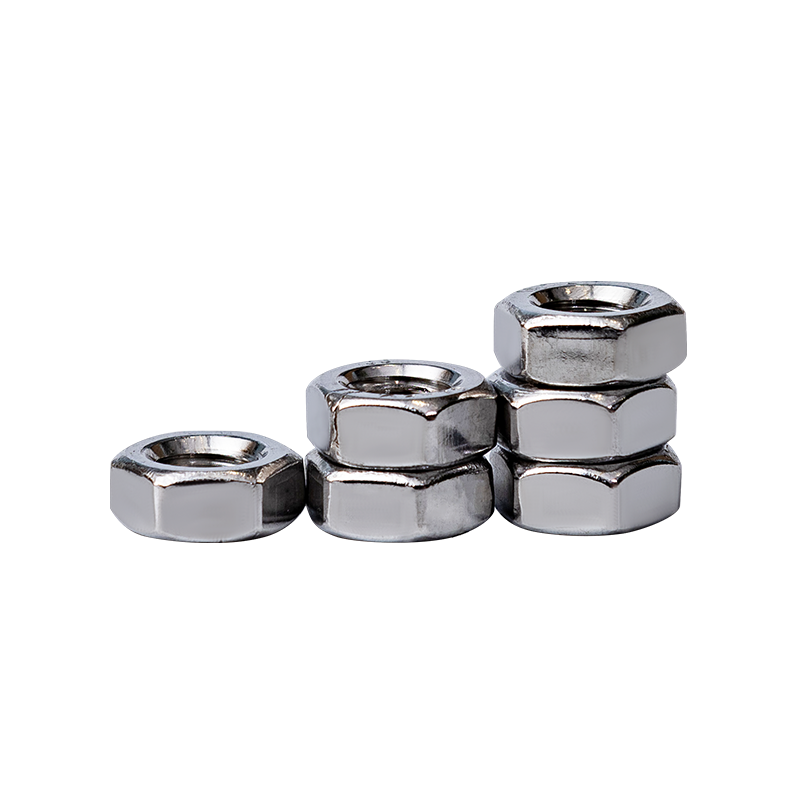 SS304 DIN934 M10 Hex Nuts for Secure Thread EngagementPair these DIN934 M10 hex nuts with matching bolts to ensure the correct thread pitch and full tensile strength. The product page emphasizes corrosion resistance and stable clamping under load, making it a practical choice for medium to heavy-duty assemblies.View Product →
How to Match Bolts and Nuts Correctly
Match the bolt and nut size chart on two values only: nominal diameter and thread pitch. If the bolt row lists M12 x 1.75 coarse pitch, order a coarse-pitch M12 nut. If the bolt is M12 x 1.25 fine pitch, a coarse nut will start and then jam, which can damage the thread. The diameter may be identical, but the thread forms are not.
Assembly conditions also change what a chart row means. A nut seating against a soft material may need a flat washer under it to distribute the clamping load. Adding washers changes the grip length of the bolt, so a bolt that was correctly sized for a bare connection can become too short once a washer stack is introduced. The chart gives nominal dimensions, not the final stack-up calculation.
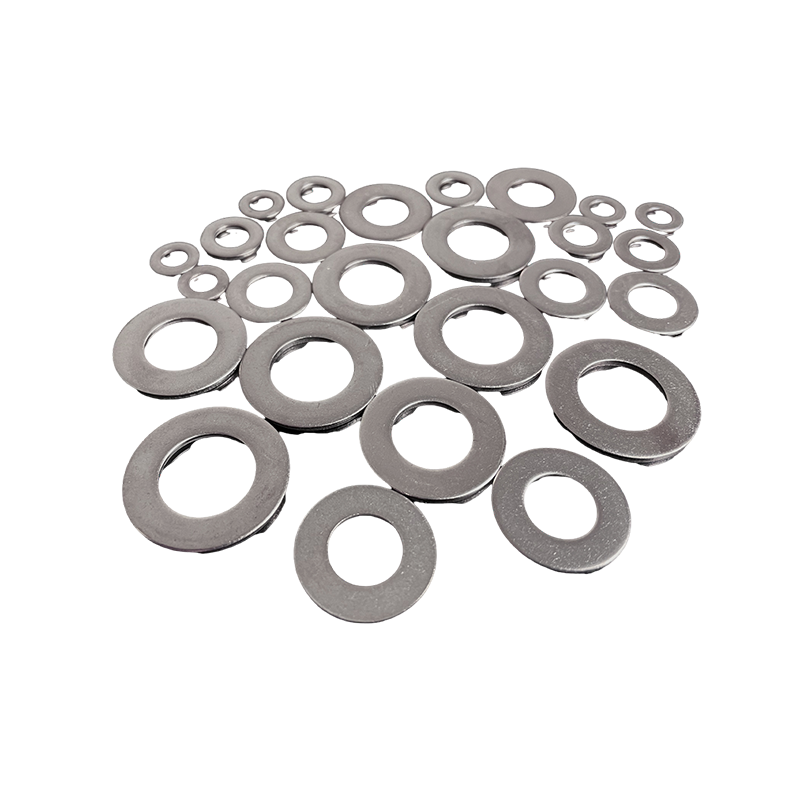 SS304 DIN125/GB97 M10 Flat Washers with Precise DimensionsThese flat washers distribute clamping load and protect surfaces, with an inner diameter of 10.5 mm, outer diameter 20 mm, and thickness 2.2 mm. The page confirms 304 stainless steel tolerances suitable for precision and corrosion-resistant applications.View Product →
Material and Standard Notes That Change How You Read the Chart
A dimensional chart does not tell you which material grade to use. In stainless steel bolting, the common choices are 304, 316, and 201. All three are available in the same M sizes and pitches, so the chart works the same way, but the mechanical properties and corrosion resistance differ. For marine and chemical environments, 316 gives better pitting resistance; for dry interior duty, 304 is the established standard.
The standard reference on the row, such as DIN 933 or DIN 934, fixes the dimensional tolerances. A part made to GB 5783 is dimensionally interchangeable with DIN 933, but the buyer should confirm material grade and strength class before assuming they are identical. In procurement, the size chart answers the dimension question; the standard and material grade answer the performance question.
Procurement Tips for Working with a Bolt and Nut Size Chart
- Measure the bolt diameter with a caliper, not by guessing against a wrench.
- Use a thread pitch gauge to confirm coarse or fine pitch before ordering nuts.
- Check whether a replacement nut follows the same standard as the original bolt, for example DIN 934, when the original drawing is unclear.
- Verify the width across flats for the nut against the chart if the bolt head was rounded and no longer fits a known spanner.
When the identification work is done, the chart becomes a fast ordering tool instead of a source of confusion. For a deeper look at hex bolt selection and typical applications, see our guide to stainless steel hex bolts.
The Practical Takeaway
A bolt and nut size chart is only complicated when it is read as a set of isolated columns. Read it as a pairing table, confirm nominal diameter with pitch, match the nut to the same values, and use the width across flats to check the wrench size. The remaining variables, material grade, standard reference, and thread engagement, come from the application, not from the row. That approach reduces assembly errors and makes fastener ordering straightforward, whether you are replacing one M10 pair or stocking hundreds of stainless steel hex bolts and nuts. You can review the complete range of stainless steel fasteners we produce on our website.

 No. 2 Bridge, Chuangxin Road, Dainan Town, Xinghua City, Taizhou City, Jiangsu Province
  +86-17315333748(Wechat)
 +86-17315333748(Wechat/Whatsapp)

