


 русский
 Español
 عربى
 italiano
A stainless steel bolt turned into an aluminum bracket looks like a sensible choice: both metals resist rust, neither needs paint, and the joint should outlast the machine around it. Then one coastal summer or one season of wash-down cleaning passes, and the aluminum around the bolt hole is covered in white, chalky paste, the threads feel loose, while the stainless steel part still looks new. Nothing is wrong with the fastener. The aluminum has been consumed as the anode of a galvanic cell that the joint itself created.
That mechanism answers the question behind this page. Stainless steel does not corrode aluminum chemically, but a stainless steel part in direct contact with aluminum can drive the aluminum to corrode far faster than it would on its own, sometimes within months.
Content
- 1 The Short Answer: Aluminum Corrodes, Stainless Steel Does Not
- 2 Three Conditions Have to Line Up Before Anything Happens
- 3 The Factors That Decide How Bad It Gets
- 4 Why a Better Stainless Fastener Can Make the Joint Worse
- 5 Five Ways to Break the Galvanic Cell
- 6 Where These Joints Fail in Real Installations
- 7 What to Put on the Purchase Order
The Short Answer: Aluminum Corrodes, Stainless Steel Does Not
When aluminum and stainless steel touch in the presence of moisture they form a galvanic couple. One metal becomes the anode and loses material; the other becomes the cathode and is protected. In this pairing the aluminum is always the anode, because it sits well below stainless steel in the galvanic series.
The driving force is the difference in corrosion potential. In seawater, aluminum alloys sit at roughly -0.75 V to -0.90 V against a saturated calomel electrode, while passivated 304 and 316 stainless steel sit near -0.05 V to +0.10 V. That gap of about 0.6 V to 0.8 V is far above the 0.25 V threshold engineers commonly use to flag a galvanic risk, which is why this combination is treated as a serious one rather than a cosmetic concern.
Three Conditions Have to Line Up Before Anything Happens
Galvanic corrosion is not automatic. All three of the following must be present at the same time:
- A potential difference large enough to drive current between the two metals.
- Electrical contact, either direct metal-to-metal contact or contact through a conductive liquid film.
- A continuous electrolyte path bridging both parts: condensation, rain, wash water, sea spray or a damp salt film.
Remove any one of the three and the reaction stops. Dry indoor joints in air-conditioned buildings, where no chlorides are present, often survive for decades with light staining at most. Field joints fail faster because of wet-and-dry cycling: every drying cycle concentrates chlorides in the crevice under a bolt head or washer, and every wetting cycle restarts the current at a higher concentration than before.
The Factors That Decide How Bad It Gets
Two identical aluminum-to-stainless joints can differ by an order of magnitude in service life. The table below shows what actually moves the outcome.
| Factor | Why it changes the outcome | Field example |
|---|---|---|
| Electrolyte conductivity | Salt water carries ionic current far better than clean condensate. | A railing 300 m from the coast versus the same railing inland. |
| Cathode-to-anode area ratio | A small aluminum anode feeding a large stainless cathode concentrates current into deep, localized loss. | Aluminum rivets in a large stainless panel age far worse than a large aluminum plate held by four stainless bolts. |
| Chloride level | Chlorides break down the aluminum oxide film and stop it from repassivating. | De-icing salt on chassis parts; marine spray on pier hardware. |
| Temperature | Reaction rates roughly double for every 10 °C rise. | Rooftop hardware in summer sun versus the same parts in a shaded frame. |
| Aluminum alloy | 2xxx and 7xxx grades are markedly more susceptible than 5xxx and 6xxx grades. | A 2024 bracket under a stainless screw versus a 6061 bracket in the same position. |
| Coating condition | Anodizing, paint or a barrier washer interrupts the current path until it is scratched or worn through. | A scratched anodized rail under a stainless clamp becomes a small anode with a large cathode. |
| Water retention | Joints that stay wet longest, or that trap chlorides, show the deepest attack. | Water pooling at the base of an aluminum upright bolted with stainless hardware. |
Notice what is missing from that list: the brand or the price of the fastener. A premium stainless bolt does not reduce galvanic risk, and in some cases it slightly increases it.
Why a Better Stainless Fastener Can Make the Joint Worse
Stainless steel protects itself with a chromium oxide film that re-forms within seconds of being scratched. That same film makes the metal an efficient cathode: the more corrosion-resistant the stainless steel, the closer it behaves to an inert electrode and the more galvanic current it pushes toward the aluminum. In a mixed-metal joint the aluminum sacrifices, while the stainless part shows only a white or grey deposit and some discoloration from aluminum corrosion products.
Two consequences follow. The damage is invisible on the part most people inspect, and the crevice between the bolt head, washer and aluminum surface traps chlorides while limiting oxygen, so the aluminum pits locally and the joint can lose clamping force without any obvious external sign.
Grade selection matters less for the couple itself than for the stainless steel's own survival. The potential difference between aluminum and 304 is nearly the same as between aluminum and 316, so upgrading does not remove the risk; it keeps the fastener from pitting in chlorides, which keeps the cathode area predictable. Comparing 304 and 316 stainless steel hex bolts before specifying for coastal or wash-down service is worth the twenty minutes.
Five Ways to Break the Galvanic Cell
Prevention means interrupting one of the three conditions, and the practical options rank roughly in this order of effectiveness:
- Isolate the metals. Nylon, PTFE, EPDM or fiber-reinforced plastic washers, sleeves and bushings keep aluminum and stainless steel out of electrical contact. A plain stainless washer isolates nothing; it only enlarges the cathode.
- Coat the aluminum side. Anodizing, chromate conversion, powder coating or a primer system keeps the anode from being exposed. Coating the stainless steel part is less useful, because the cathode does not need to corrode for the couple to work.
- Seal and drain the joint. A neutral-cure silicone or polyurethane sealant keeps electrolyte out of the interface, and a drain path stops water pooling. Do not rely on sealant alone where the joint is submerged or continuously sprayed.
- Control the area ratio. Where contact is unavoidable, keep the aluminum anode large and the stainless cathode small. A few stainless screws in a large aluminum plate are acceptable; small aluminum rivets in a large stainless sheet are not.
- Accept a sacrificial material when servicing is planned. Zinc-plated fasteners are anodic to aluminum and will protect it, at the cost of consuming the coating and eventually rusting. That trade-off suits short-life equipment with scheduled maintenance, not a permanently installed structure.
Where These Joints Fail in Real Installations
Solar mounting structures
Aluminum rails and module frames fastened with stainless bolts are standard on rooftop and ground-mount arrays. Inland joints usually age well, but coastal arrays, agricultural sites with ammonia and dust, and locations with heavy dew show white corrosion product around clamp bolts after two to three years. Isolating washers at the rail-to-clamp interface and drainage slots at the low end of each rail solve most of it.
Marine and offshore hardware
Aluminum superstructures, handrails and deck fittings are commonly bolted with stainless fasteners. Here 316 or a higher-alloy stainless is the baseline, the aluminum should be a 5xxx or 6xxx grade, and the joint should be bedded in sealant with an isolating pad. Where chloride levels are high and inspection intervals are long, an M10 hex nut to DIN 934 in grade 316 is a common choice.
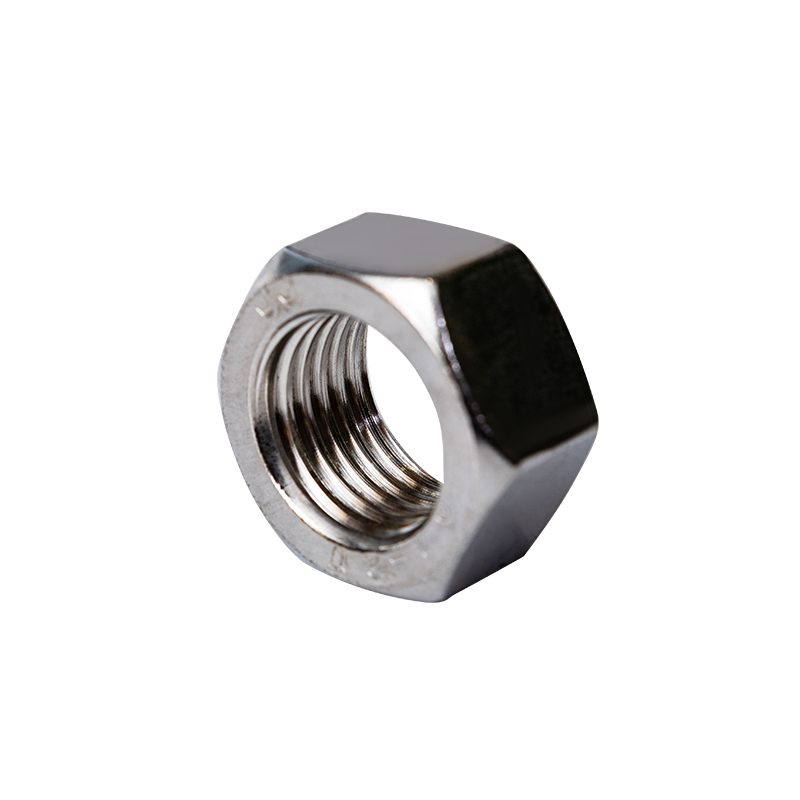 SS316 DIN934 M10 Hex NutsFor aluminum superstructures and deck fittings, this SS316L M10 DIN934 nut matches the grade 316 hex nut commonly specified for chloride-rich joints.View Product →
Facades, windows and railings
Aluminum window frames, curtain wall brackets and handrails are frequently fixed with stainless screws and anchors. Rain, de-icing salts at street level and interior condensation all supply the electrolyte. Failure appears first as staining on the aluminum and as loose fixings in the lower sections of a facade, where water collects.
What to Put on the Purchase Order
A fastener supplier can only control the metal it ships, so the specification has to cover the whole joint. Four lines belong on the order for any aluminum-to-stainless assembly, for example SS304 hexagon head bolts to DIN 933, SS316 hex nuts to DIN 934, SS304 flat washers to DIN 125 or SS304 threaded rods to DIN 975:
- Grade, material and standard for every part, so bolts, nuts and washers match.
- Isolating components listed separately, with material, hardness and thickness, so they arrive as a kit instead of being sourced later.
- Aluminum finish, including anodizing class and thickness, plus the sealant type approved for the interface.
- Documentation and inspection: material certificates, coating test data and a first-year joint inspection in the maintenance plan.
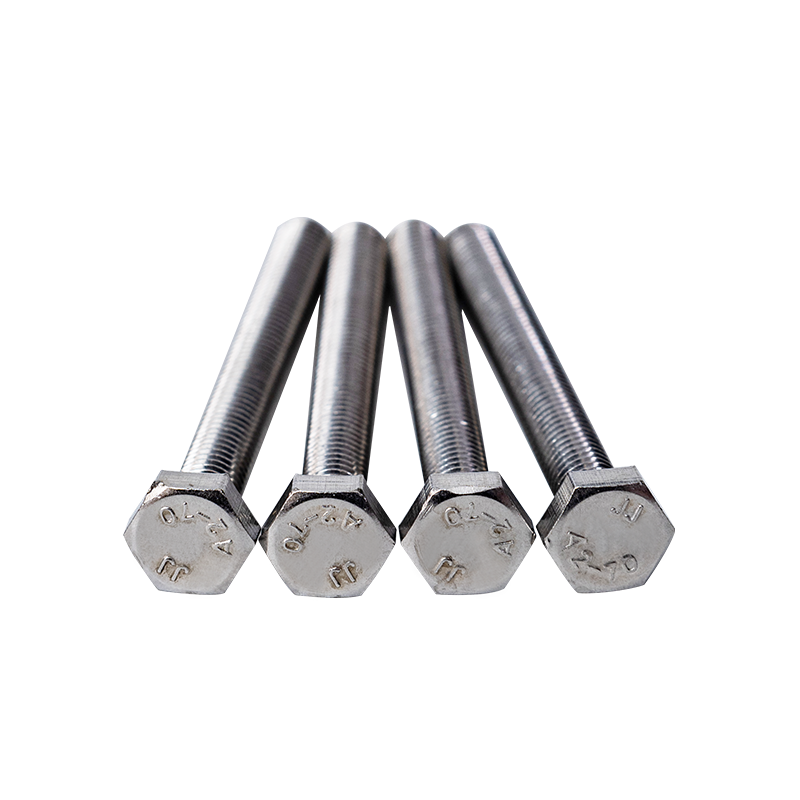 SS304 DIN933 M10 Hexagon Head BoltsFor aluminum-to-stainless assemblies, this SS304 DIN933 M10 hex bolt is a specified fastener line, available in lengths from 16 mm to 200 mm.View Product →
Anti-seize compounds deserve a separate line. Copper-based and graphite-based pastes are cathodic to aluminum and will accelerate attack inside a thread, so a ceramic-filled or PTFE-based product is the safer choice on aluminum threads.
The honest conclusion is that stainless steel does not corrode aluminum, but it does make aluminum corrode. The stainless part is not faulty, and no amount of polishing or upgrading will change the electrochemistry. What changes the outcome is isolation, drainage, coating and the discipline to keep the isolating washer in the joint, decisions that are cheapest at the drawing stage and most expensive after the first season of service.

 No. 2 Bridge, Chuangxin Road, Dainan Town, Xinghua City, Taizhou City, Jiangsu Province
 +86-17315333748(Wechat)
 +86-17315333748(Wechat/Whatsapp)

