


 русский
 Español
 عربى
عربى italiano
A maintenance team at a coastal water treatment plant replaced a steel mounting bracket with an aluminium equivalent and reused the original SS304 bolts. Ten months later the bolts looked untouched. The aluminium around every bolt hole had turned chalky white and had pitted to roughly half its original thickness.
That lopsided result answers the question directly. Stainless steel does react with aluminium, and the reaction is galvanic corrosion. It rarely damages the stainless steel. It consumes the aluminium. Whether it matters in a given assembly comes down to moisture, electrical contact and how long the joint has to survive.
Content
- 1 The short answer: yes, they react, but three conditions must line up
- 2 Why the reaction targets aluminium and spares the stainless
- 3 Where the reaction actually bites in practice
- 4 How to stop the reaction: isolation first, material choice second
- 5 Choosing stainless hardware for aluminium structures
- 6 Installation mistakes that shorten joint life
The short answer: yes, they react, but three conditions must line up
Galvanic corrosion needs all three of the following at once: two metals with different electrochemical potentials, direct electrical contact between them, and an electrolyte to carry ions. The electrolyte is usually a film of water, condensation, salt spray or humid air carrying chlorides. Remove any one of the three and the reaction effectively stops.
When all three are present, aluminium sits far below stainless steel on the galvanic series. In seawater the potential gap between a passive stainless surface and aluminium is roughly 0.6 to 0.9 volts, which is a large driving force by fastener standards. Aluminium becomes the anode and loses metal. Stainless steel becomes the cathode and is protected by the very arrangement that damages its neighbour.
| Material in the joint | Galvanic role | What happens over time |
|---|---|---|
| SS316, passive surface | Cathodic | Largely unchanged; drives the couple |
| SS304, passive surface | Cathodic | Similar role, slightly weaker driving force |
| Aluminium, mill finish | Anodic | Loses metal, pits at contact and crevice points |
| Aluminium, anodised | Anodic, with a resistive film | Attack slows until the film is scratched or cracked |
| Zinc-plated steel washer | Intermediate | Adds a third potential and unpredictable behaviour |
In dry indoor service a stainless-to-aluminium joint is usually stable for decades. In a marine atmosphere the same joint can show visible aluminium loss within a single season.
Why the reaction targets aluminium and spares the stainless
The galvanic series decides which metal loses
The series ranks metals by how readily they give up electrons in a given environment. SS316 sits above SS304, and both sit well above aluminium. That ranking is fixed by chemistry rather than surface finish, so polishing or painting the aluminium does not change which metal plays the anode.
Area ratio is the rule most people get backwards
Attack speed depends heavily on the ratio of anode area to cathode area. A small anode feeding a large cathode corrodes very fast, because the current from a big cathodic surface concentrates on a tiny patch of anodic metal. The practical warning is this: an aluminium fastener or a thin aluminium sheet inside a large stainless structure is the worst case, while a small stainless bolt in a large aluminium plate is the milder one.
Passivation helps the stainless and does nothing for the aluminium
Stainless steel protects itself with a chromium oxide film that reforms after a scratch, which is why the fasteners in the opening example still looked new. Aluminium also forms an oxide layer, and anodising thickens it into a deliberate barrier. That barrier is brittle, though. Over-torqued bolts, cut edges and thread engagement break it, and the exposed metal at those points becomes the anode for the rest of the coated surface.
Where the reaction actually bites in practice
A dry, painted indoor assembly with coated contact faces will often last the service life of the equipment without measurable aluminium loss. The environments below are where galvanic damage turns into a maintenance cost.
- Coastal and offshore structures, where chloride spray keeps the joint wet and conductive for much of the year.
- Road and rail assets exposed to de-icing salts, which stay aggressive even at low humidity.
- Washdown areas in food and beverage plants, where hot detergent reaches the joint daily.
- Swimming pool halls and chemical plants, where airborne chlorides or acids condense on cold metal.
- Permanently wet or buried joints, where no drying cycle interrupts the current.
The failure signature is consistent: a white or grey aluminium oxide gel at the interface, seized threads, and falling clamp load as aluminium is consumed under the head and nut face. Fasteners that feel loose but refuse to turn are a classic sign of galvanic attack.
How to stop the reaction: isolation first, material choice second
Isolation is the most reliable fix because it removes electrical contact, one of the three conditions the reaction needs. The methods below are ranked from most to least effective in wet service.
- Insulating shoulder washer plus a sleeve through the hole. The sleeve keeps the shank off the aluminium bore, the washer keeps the head and nut face off the plate, and the joint still carries full clamp load. Expect to adjust torque values, because nylon creeps under sustained load.
- Bonded sealing washers or polymer-coated fasteners, which achieve similar isolation with fewer loose parts.
- Barrier pastes or sealants applied to threads and under heads. They block the electrolyte rather than the contact, so they perform well alongside isolating hardware and poorly on their own.
- Anodising or painting the aluminium, with drilled holes and cut edges touched up afterwards. This raises the resistance of the anode surface but does not remove contact.
- Designing for the anode. If isolation is impractical, use aluminium fasteners, fit stainless threaded inserts, or specify a much larger aluminium area so current density at the anode stays low.
- Avoiding a third metal. A zinc-plated washer between a stainless bolt and an aluminium plate adds another potential difference to the stack and makes the outcome harder to predict.
Two rules sit above all of these. Keep the joint dry, with drain paths and no water traps around the fastener. And never assume that one untreated bolt is harmless while the rest of the joint is isolated, because a single conductive path is enough for the whole couple to work. For load distribution rather than electrical isolation, flat washers are still worth fitting under heads and nuts, since they spread clamp load and reduce the chance of cracking a hard anodised surface.
Where vibration loosens an aluminium assembly, self-locking nuts help hold preload without adding an aggressive metal to the stack.
Choosing stainless hardware for aluminium structures
Grade selection should follow the environment. SS304 handles inland, indoor and dry-service aluminium joints comfortably. SS316 is the better choice near salt water, in chemical plants and anywhere chlorides are present, because its molybdenum content delays pitting. The price difference is small next to the cost of replacing a corroded assembly. If you are weighing grades for a specific structure, this comparison of 304 and 316 stainless steel hex bolts explains where the extra alloy content pays for itself.
Bolted aluminium frames and brackets commonly use SS304 DIN933 hexagon head bolts in M6 to M24 with matching nuts, because these paired standards are easy to source and re-order in mixed sizes.
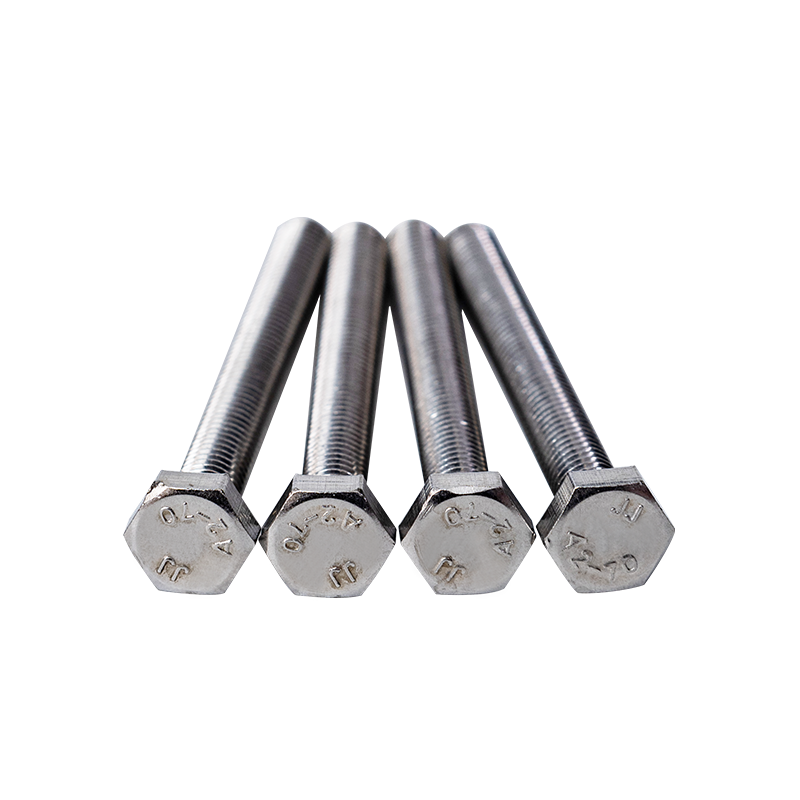 SS304 DIN933 M10 Hexagon Head Bolts for FramesA stainless steel M10 hex bolt in DIN933 dimensions with A2-70 marking and 16–200 mm lengths, suited to bolted aluminium frame and bracket joints.View Product →
 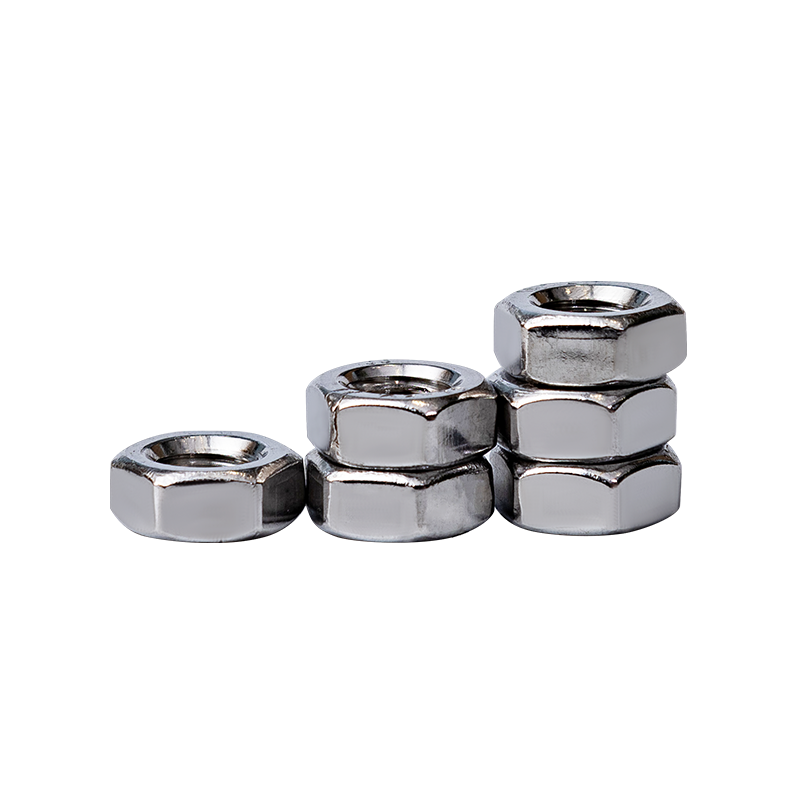 SS304 DIN934 M10 Hex NutsA stainless steel M10 coarse-thread hex nut in DIN934 dimensions with A2-70 marking, paired with SS304 DIN933 bolts for secure clamping in frame joints.View Product →
For higher-chloride sites, the same joint specified in SS316 hardware, or in SS304 with full isolation, gives noticeably better pitting resistance across a long service life.
Installation mistakes that shorten joint life
Most premature failures in stainless-to-aluminium joints come from installation rather than material selection.
- Over-torquing. Excess preload cracks the anodised layer or coating under the head and exposes bare aluminium at the highest-stress point.
- Driving stainless self-tapping screws into thick aluminium without a pilot hole. The thread tears through the oxide film, generates heat, and can gall the screw in place.
- Leaving stainless swarf or wire-brush residue on the aluminium surface. Embedded particles become small cathodes that pit the surrounding metal.
- Skipping isolation on one or two fasteners because they look sheltered. A single conductive path restarts the couple.
- Pairing stainless bolts with galvanised nuts and washers on an aluminium plate, which creates an unpredictable three-metal stack.
A short pre-assembly check covers most of these: confirm the pilot hole size, verify that every fastener in a wet location has an insulating sleeve and washer, and set torque against the isolating hardware rather than the bare-metal specification.
Stainless steel and aluminium are not an impossible pairing. In dry, indoor, well-coated assemblies the galvanic reaction is slow enough to ignore. In wet, salty or chemically aggressive service it is fast enough to destroy the aluminium side of a joint within a couple of seasons, even while the stainless fasteners still look new.
The working rule is straightforward. If the joint will ever get wet and the aluminium is the structural member, isolate it with a sleeve and an insulating washer, seal it against standing water, and specify a grade such as SS316 where chlorides are present. If the assembly stays dry, the same stainless hardware will usually outlast the machine it holds together.

 No. 2 Bridge, Chuangxin Road, Dainan Town, Xinghua City, Taizhou City, Jiangsu Province
  +86-17315333748(Wechat)
 +86-17315333748(Wechat/Whatsapp)

