


 русский
 Español
 عربى
 italiano
A cabinetmaker driving a #8 wood screw into a piece of white oak learns the lesson quickly: the screw stops halfway, the bit smokes, and a split runs along the grain. The fix is usually not more force. It is the pilot hole. The drill size for an 8 screw depends on which “8” you mean. For a standard #8 wood screw, start with a 3/32-inch bit in softwood and a 7/64-inch bit in hardwood. For an M8 metric coarse-thread tap, use a 6.8 mm drill. Those two numbers are not interchangeable, and treating them as if they were is one of the most common drilling mistakes in mixed imperial and metric work.
Content
First, Separate a #8 Wood Screw from an M8 Metric Fastener
A #8 wood screw is an imperial gauge size, not a decimal inch or a metric diameter. Its major diameter is about 0.164 inch, or roughly 4.17 mm. An M8 fastener has an 8 mm nominal diameter. That makes the M8 shank nearly twice the diameter of a #8 screw, so a pilot hole that works for one will be badly wrong for the other.
The confusion appears in search results and shop conversations because “8 screw” can mean a #8 wood screw, an M8 machine screw, an M8 tap, or even a clearance hole for an M8 bolt. Before choosing a bit, confirm the fastener type, thread pitch, and material being joined. A #8 wood screw needs a pilot hole sized to its core so the threads can bite. An M8 tap needs a hole sized to leave enough material for the thread crest. An M8 clearance hole needs to let the bolt pass without binding.
Drill Size for a #8 Wood Screw by Material
For a standard #8 wood screw, the pilot bit should be close to the screw’s solid core, not its full outside thread diameter. Softwood compresses more, so a smaller bit is usually enough. Hardwood has less give, and dense species split more readily, so the pilot hole steps up slightly. The table below gives practical starting points; a scrap test is still the final check because species density, moisture content, and screw thread shape vary.
| Material | Pilot bit (inch) | Pilot bit (mm) | When to adjust |
|---|---|---|---|
| Softwood such as pine, fir, or cedar | 3/32 | 2.4 | Step up to 7/64 inch if the screw drives hard or the wood is resinous. |
| Hardwood such as oak, maple, or ash | 7/64 | 2.8 | Use 1/8 inch for dense grain, knots, or long screws that generate heat. |
| Very dense hardwood or engineered lumber | 1/8 | 3.2 | Stop increasing once the screw bites firmly; too large a hole loses holding power. |
A useful tolerance check is the screw’s behavior in scrap. The bit should remove a clean core, the screw should start without wobbling, and the threads should still cut visible grooves in the hole wall. If the bit falls through under its own weight, the hole is likely too large. If the screw squeaks, smokes, or splits the wood, the bit is too small or the hole is too shallow.
Drill Size for an M8 Metric Screw and Tap
When the “8 screw” is metric, the drill size depends on the operation. For a standard M8 coarse thread tap with a 1.25 mm pitch, the usual tap drill is 6.8 mm. For an M8 fine thread with a 1.0 mm pitch, use 7.0 mm. These holes are for cutting threads, not for clearing a bolt. If the goal is a clearance hole, a close-fit M8 hole is about 8.4 mm, while a general assembly hole is often 9.0 mm.
| M8 application | Drill size | Practical note |
|---|---|---|
| M8 x 1.25 coarse tap | 6.8 mm | Standard tap drill for steel, aluminum, and stainless; use cutting fluid in stainless. |
| M8 x 1.0 fine tap | 7.0 mm | Fine pitch leaves more material in the thread, so the hole is slightly larger. |
| M8 close-fit clearance | 8.4 mm | For precision alignment where little play is acceptable. |
| M8 standard clearance | 9.0 mm | General assembly with slight play for paint, coating, or misalignment. |
Metric wood screws are less standardized than machine screws. For an 8 mm wood screw, start near the root diameter, often around 5 mm in softwood, and test in scrap before stepping up for dense hardwood. The same logic applies: the pilot hole must leave enough material for the thread to cut, but not so much that the screw has to force its way in.
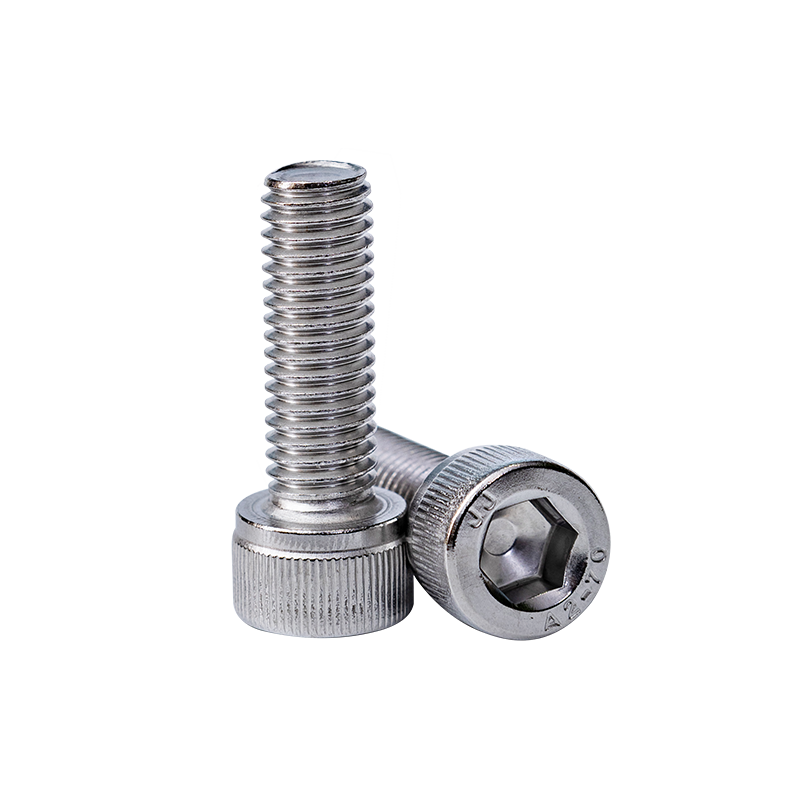 SS304 DIN912 M8 Socket Head Cap ScrewsIf your project calls for stainless socket head cap screws rather than wood screws, this M8 DIN912 range spans 8–606 mm and is A2-70 marked.View Product →
How to Check the Fit Before Drilling the Workpiece
Drill a test hole in an offcut from the same board. This matters more than a chart when the wood is reclaimed, pressure-treated, or unusually dry. Drive a screw to the expected depth and watch three things: the drive torque, the hole wall, and the exit side. A good pilot hole lets the screw pull itself in with steady resistance. A hole that is too small raises torque sharply and can shear the screw or split the piece. A hole that is too large lets the screw spin or strip under load.
For hardwoods, drill the pilot hole slightly deeper than the screw’s threaded length, especially when using a tapered wood screw. For flat-head screws, add a countersink before driving so the head seats without crushing fibers. For repeated assembly, set the clutch low and increase it only after the screw is seated. These steps do not change the drill size for an 8 screw, but they make the chosen size behave consistently.
Wood, Metal, and Outdoor Fasteners
A #8 wood screw and an M8 machine screw belong in different assemblies. Wood screws rely on thread engagement in a compressible material. Machine screws rely on a tapped hole, a nut, or a threaded insert. If you are working with stainless fasteners for damp or coastal conditions, check the fastener grade and the hole preparation together. This guide on stainless steel self-tapping screws for outdoor use explains how exposure affects fastener choice and installation. The drill size still starts with the screw’s core or nominal diameter, but the material and environment decide whether stainless is the right starting point.
For M8 stainless socket-head screws in equipment frames, jigs, or damp service areas, the tap drill remains 6.8 mm for a coarse thread. The difference is in the drilling technique: use a sharp bit, keep the drill perpendicular, clear chips, and use cutting fluid when tapping stainless. A slightly oversized or wandering hole can reduce thread engagement, so mark the hole and spot-drill before the full depth.
The practical answer is short. For a #8 wood screw, begin with 3/32 inch in softwood and 7/64 inch in hardwood, moving to 1/8 inch only when dense grain demands it. For an M8 coarse tap, use 6.8 mm; for an M8 clearance hole, choose 8.4 mm or 9.0 mm based on fit. Confirm the fastener first, test on scrap second, and drill the workpiece last. That order prevents split boards, stripped holes, and the costly habit of solving a pilot-hole problem with a bigger driver.

 No. 2 Bridge, Chuangxin Road, Dainan Town, Xinghua City, Taizhou City, Jiangsu Province
 +86-17315333748(Wechat)
 +86-17315333748(Wechat/Whatsapp)

