


 русский
 Español
 عربى
عربى italiano
Content
Why Fastener Markings Exist
A bolt with no visible markings and one stamped with three radial lines can look nearly identical in a parts bin. The difference in tensile strength between them can exceed 30,000 PSI. Fastener markings exist precisely because that difference is invisible to the eye — and using the wrong grade in a load-bearing application can result in fastener failure with no warning.
Markings serve two distinct functions. The first is performance identification: the grade, property class, or strength rating stamped on a fastener tells the installer exactly what load that fastener is designed to carry. The second is traceability: manufacturer identification marks — letters, logos, or symbols registered to specific producers — allow individual fasteners to be traced back to a production batch in the event of a quality issue or recall. Both functions are mandatory requirements under the major standards that govern fastener production.
Three organizations define the marking systems most commonly encountered in global manufacturing and construction: the Society of Automotive Engineers (SAE), the International Organization for Standardization (ISO), and ASTM International. Each uses a different marking language, and all three systems may appear on fasteners within the same facility or project. Understanding all three is the baseline for competent fastener selection.
SAE Bolt Head Markings: Radial Line System
SAE J429 governs inch-series bolts used primarily in North America. Under this standard, bolt strength grade is communicated through a pattern of radial lines stamped on the top of the hex head. The line count follows a formula: the number of lines equals the grade number minus two. This means a Grade 2 bolt carries no radial lines, a Grade 5 bolt carries three lines, and a Grade 8 bolt carries six lines.
| SAE Grade | Head Marking | Min. Tensile Strength | Typical Application |
|---|---|---|---|
| Grade 2 | No radial lines | 74,000 PSI | General purpose, non-critical assemblies |
| Grade 5 | 3 radial lines (at 12, 4, 8 o'clock) | 120,000 PSI | Automotive, machinery, general industrial |
| Grade 8 | 6 radial lines (evenly spaced) | 150,000 PSI | High-stress industrial, suspension, heavy equipment |
In addition to the grade lines, every SAE-compliant bolt over ¼" diameter must carry a manufacturer's identification mark — a letter, symbol, or combination unique to that producer and registered with the relevant standards body. This mark appears alongside the radial lines on the bolt head. A bolt with grade lines but no manufacturer mark does not fully comply with SAE J429 and should be treated with caution in critical applications.
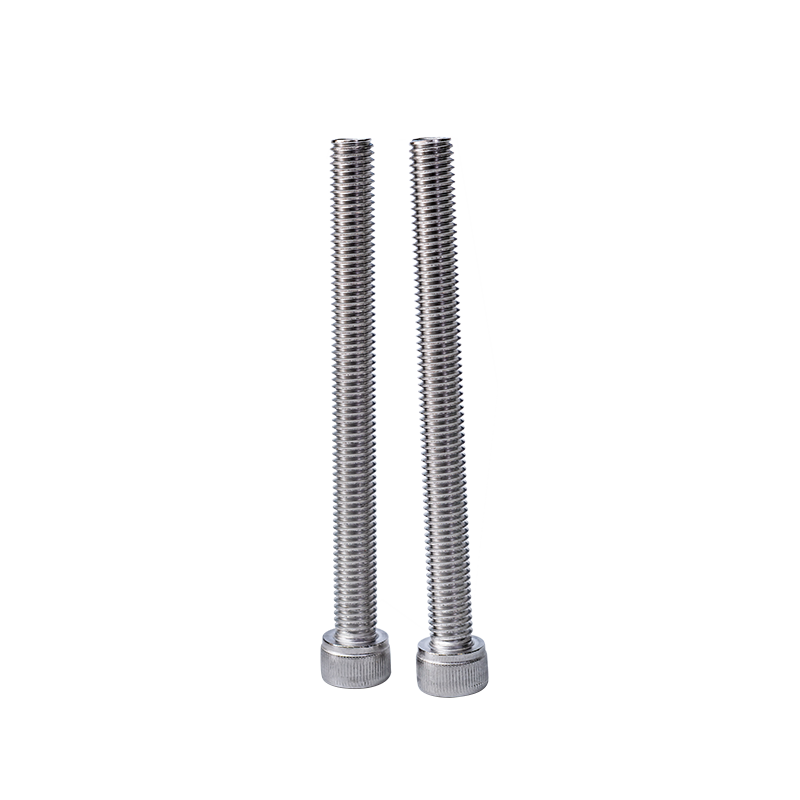
Allen bolts and socket head cap screws present a variation on this system. Because the recessed drive socket occupies most of the head face, radial lines are rarely used. Instead, allen bolts with socket head are typically marked with a property class number on the side of the head or on the socket face — most commonly 12.9 for high-strength alloy steel versions, following the ISO system described in the next section.
Metric Bolt Markings: ISO Property Class System
ISO 898-1 governs metric bolts and uses a numerical property class system rather than radial lines. The class is stamped directly on the bolt head as two numbers separated by a dot — for example, 8.8, 10.9, or 12.9. These numbers encode both minimum tensile strength and yield ratio in a single compact marking.
Reading the property class is straightforward once the formula is understood. The number before the decimal, multiplied by 100, gives the approximate minimum tensile strength in megapascals (MPa). The number after the decimal, multiplied by 10, gives the yield strength as a percentage of tensile strength. So a class 10.9 bolt has a minimum tensile strength of approximately 1,000 MPa and a yield strength of approximately 90% of that value — meaning it begins to deform permanently at around 900 MPa.
| Property Class | Min. Tensile Strength | Yield Strength Ratio | SAE Approximate Equivalent |
|---|---|---|---|
| 5.8 | 500 MPa | 80% | Below Grade 5 |
| 8.8 | 800 MPa | 80% | Comparable to Grade 5 |
| 10.9 | 1,000 MPa | 90% | Comparable to Grade 8 |
| 12.9 | 1,200 MPa | 90% | No direct SAE equivalent — highest standard metric class |
Stainless steel metric bolts use a separate marking convention under ISO 3506. The format combines a material code and strength designation: A2-70 indicates 304 stainless steel with a minimum tensile strength of 700 MPa; A4-70 indicates 316 marine-grade stainless steel at the same strength level; A4-80 indicates 316 stainless at 800 MPa. The "A" prefix identifies austenitic stainless steel. Stainless steel hexagon head bolts are commonly produced to A2-70 or A4-70 specifications depending on the corrosion resistance requirements of the application environment.
ASTM Structural Bolt Markings
ASTM International defines fastener standards primarily used in structural and construction applications. Unlike the SAE radial line system or the ISO numeric system, ASTM bolts are typically marked with alphanumeric grade designations stamped directly on the bolt head, accompanied by a manufacturer identification mark.
ASTM A307 covers carbon steel bolts for general structural use. Grade A bolts carry no specific marking beyond the manufacturer's mark; Grade B bolts for flanged pipe joints are similarly identified. These are relatively low-strength fasteners for non-critical structural connections.
ASTM A325 is the standard for high-strength structural bolts used in steel-to-steel connections. The bolt head is marked "A325" along with the manufacturer's identification symbol. These bolts have a minimum tensile strength of 120,000 PSI for diameters up to 1" and are the standard specification for structural steel construction in North America.
ASTM A490 covers ultra-high-strength structural bolts with a minimum tensile strength of 150,000 PSI. The head is marked "A490." These are specified for the most demanding structural connections — heavy steel frames, bridge construction, and industrial structures subject to significant dynamic loading.
An important distinction: ASTM bolts must never be substituted with SAE bolts of apparently similar strength without verifying that both the mechanical properties and the dimensional standards match. The standards are developed for different end-use environments and their equivalency is not direct.
Nut Markings: The Clock Position System
Nut markings follow a different logic from bolt markings, partly because the flat bearing face of a hex nut offers less marking area than a bolt head, and partly because nuts of different grades are often used interchangeably in ways that make visual identification on the bearing face impractical. The SAE system addresses this with a clock position marking on one of the hex flats.
Under SAE J995, the grade of a hex nut is indicated by a single radial mark on one flat, positioned to correspond to the hour position on a clock face that matches the grade number. A Grade 5 nut carries a mark at the 5 o'clock position. A Grade 8 nut carries a mark at the 8 o'clock position. This allows grade identification even when the bearing face is against a surface or washer.
The marks may be either raised (embossed during forming) or indented (stamped after forming) — both are permissible under the standard. Some nuts also carry a manufacturer's identification mark on the bearing face or on an adjacent flat.
ASTM A563 governs the marking requirements for structural hex nuts used in conjunction with A325 and A490 bolts. Under this standard, nut grade is identified by a combination of Arabic numerals and letters stamped on the nut face. For a detailed breakdown of the specific marking requirements and grade designations, ASTM A563's official standard specification for carbon and alloy steel nuts provides the authoritative reference. Stainless steel hex nuts follow ISO 3506-2 and are marked with the same A2 or A4 material code as their matching bolt, ensuring the corrosion resistance classification is visible on both mating components. Hexagon flange nuts carry grade markings on the flange face or the hex flat, depending on the manufacturer's production process.
Surface Finish and Coating Marks
Beyond strength grade, fastener markings sometimes communicate surface treatment — the coating or finish applied after manufacture to provide corrosion resistance, lubricity, or specific electrical properties. These marks are less standardized than grade markings but follow recognizable conventions.
Zinc plating (electroplated): Often indicated by the suffix "Zn" or a color code (typically clear/silver for standard zinc plate). No universal stamped marking exists, but product documentation and packaging will specify the plating standard (e.g., ISO 4042 or ASTM B633).
Hot-dip galvanizing: Produces a thick zinc coating recognizable by its matte, slightly rough texture. Galvanized structural fasteners meeting ASTM A153 are specified in procurement documents rather than marked on the fastener itself, as the coating thickness makes additional stamping impractical on smaller diameters.
Stainless steel grades: As described in the metric marking section, A2 and A4 markings on bolt heads and nut faces directly communicate material and corrosion resistance class. This is the clearest example of a surface/material property encoded directly into the fastener marking system.
Black oxide / phosphate: These conversion coatings provide minimal corrosion resistance and are typically used for aesthetic purposes or mild indoor applications. No standardized marking exists; identification is by visual inspection of the dark matte or black surface finish combined with product documentation.
When surface finish affects the torque-tension relationship — as it does with lubricated or waxed fasteners — the coating specification becomes a critical element of the installation procedure, not just a corrosion consideration. Dry-film-lubricated fasteners often carry a "wax" or "Teflon" notation in product documentation rather than a stamped mark.
Using Markings for Procurement Verification
For buyers and quality managers sourcing fasteners in volume, head markings are the first-line verification tool for incoming inspection. A shipment of bolts claiming to be Grade 8 or property class 10.9 should be spot-checked against the marking specifications before being accepted into stock — visual marking verification takes seconds per piece and catches the most common forms of grade misrepresentation or packaging error.
The two most important procurement checks are: first, confirm that the grade marking matches the purchase specification exactly; second, confirm that a manufacturer identification mark is present alongside the grade marking. A bolt with grade lines but no manufacturer mark does not meet the full requirements of SAE J429 or ISO 898-1 and cannot be traced in the event of a quality failure. Unmarked bolts should be treated as Grade 2 / property class 5.8 regardless of any verbal or packaging claims.
Nut and bolt grades must also be matched correctly. The general rule is that the nut grade must be equal to or greater than the bolt grade — pairing a Grade 5 nut with a Grade 8 bolt leaves the joint with the weaker component as the failure point, defeating the purpose of using the higher-grade bolt. Self-locking nuts carry grade markings under the same SAE and ISO conventions as standard hex nuts; their locking function does not alter the grade classification or the matching requirement.
Finally, SAE and metric fasteners must never be mixed in the same joint. Despite apparent similarities in strength between, for example, SAE Grade 5 and ISO 8.8, the thread forms and pitches are incompatible. Cross-threading a metric bolt into an SAE-tapped hole — or vice versa — will result in a joint that appears assembled but carries a fraction of its rated load capacity. Marking systems exist specifically to prevent this: a bolt marked with radial lines is inch-series; a bolt marked with a property class number is metric. That distinction is visible in under one second on any marked fastener.

 No. 2 Bridge, Chuangxin Road, Dainan Town, Xinghua City, Taizhou City, Jiangsu Province
  +86-17315333748(Wechat)
 +86-17315333748(Wechat/Whatsapp)

