


 русский
 Español
 عربى
عربى italiano
Content
- 1 Why Engineers Choose Stainless Steel Bolts for Aluminium Assemblies
- 2 The Galvanic Corrosion Problem Explained
- 3 Choosing the Right Grade: SS304 vs SS316
- 4 Isolation Strategies to Prevent Galvanic Attack
- 5 Thread Engagement and Mechanical Considerations
- 6 Industry Applications and Best Practice Summary
Why Engineers Choose Stainless Steel Bolts for Aluminium Assemblies
Aluminium dominates modern structural design for a straightforward reason: it delivers exceptional strength-to-weight ratio, natural corrosion resistance, and ease of fabrication. From marine superstructures and solar mounting frames to curtain wall facades and automotive subframes, aluminium alloy components appear wherever weight reduction is a design priority. The challenge is fastening them securely.
Aluminium fasteners exist, but they lack the tensile strength and hardness needed in demanding joints — particularly where vibration, dynamic loading, or frequent assembly and disassembly are factors. Carbon steel bolts offer the strength, but corrode readily in the same wet and outdoor environments where aluminium excels. Stainless steel bolts resolve this conflict: they match or exceed carbon steel in strength while resisting atmospheric corrosion, making them the practical choice for the vast majority of aluminium assembly applications.
The pairing appears across industries. Solar panel racking systems bolt stainless fasteners into extruded aluminium rails. Marine deck hardware anchors through aluminium plate with stainless hex bolts. Architectural cladding systems clamp aluminium panels using stainless fixings designed to last the building's service life without replacement. In each case, the combination works — provided engineers understand and manage the one significant risk the pairing carries: galvanic corrosion. Explore the full range of stainless steel hexagon head bolts for structural fastening suited to aluminium assembly applications.
The Galvanic Corrosion Problem Explained
Galvanic corrosion is not a theoretical concern — it is a well-documented failure mechanism that has compromised structures, voided warranties, and caused expensive rework when ignored at the design stage. Understanding why it occurs is the first step toward preventing it.
Three conditions must exist simultaneously for galvanic corrosion to develop: two electrochemically dissimilar metals must be in contact, an electrically conductive path must connect them, and a liquid electrolyte must be present to carry ions between the metals. Remove any one of these three conditions and galvanic corrosion stops. This is the practical foundation of every prevention strategy.
In the stainless steel / aluminium pairing, the electrochemical positions of the two metals are well separated. Aluminium sits toward the active (anodic) end of the galvanic series, while stainless steel sits toward the noble (cathodic) end. The potential difference between them is approximately 0.5 volts in most environments — a gap large enough to drive meaningful corrosion current when moisture bridges the joint. The consequence is that aluminium, as the less noble metal, becomes the anode and corrodes preferentially, while the stainless steel bolt is protected. The reference framework for assessing these risks is ASTM G82, the standard guide for developing and using galvanic series charts to predict dissimilar-metal corrosion performance.
The rate at which galvanic attack proceeds depends heavily on environment. In dry indoor conditions, the risk is negligible — without an electrolyte, no corrosion cell forms. In humid outdoor environments, and especially in marine or coastal settings where salt-laden moisture is a near-constant presence, the same joint can degrade rapidly. Industrial atmospheres with acidic pollutants accelerate the process further. Engineers must design for the worst credible exposure, not average conditions.
One factor that works in the designer's favor is the area ratio between the two metals. Galvanic corrosion distributes attack across the anodic surface area. A small stainless bolt fastening a large aluminium panel spreads any galvanic current over a substantial aluminium area, keeping local attack rates low. The reverse — small aluminium fasteners in large stainless components — concentrates attack on a small anode and leads to rapid failure. This is why stainless bolts in aluminium structures are a far safer configuration than aluminium rivets in stainless frameworks.
Choosing the Right Grade: SS304 vs SS316
Not all stainless steel performs equally in contact with aluminium, and grade selection has a direct bearing on long-term joint integrity. The two grades that appear in the overwhelming majority of aluminium fastening applications are 304 and 316, and the choice between them is determined by the corrosivity of the service environment.
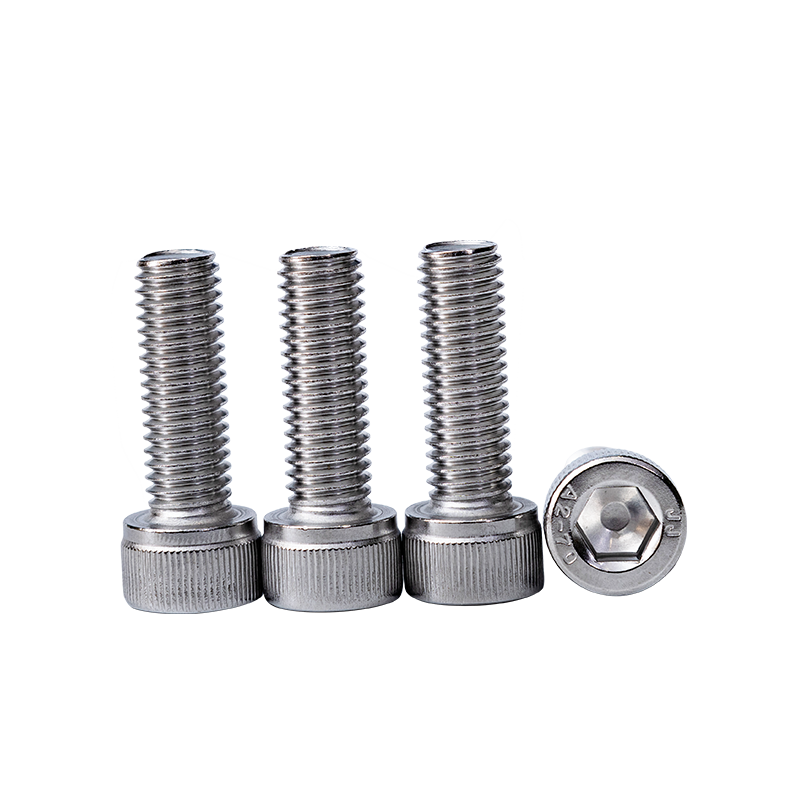
Grade 304 (18% chromium, 8% nickel) is the workhorse of stainless fasteners. Its passive chromium oxide layer provides reliable corrosion resistance in atmospheric and mildly corrosive environments. For indoor aluminium assemblies, sheltered outdoor structures, and applications in low-humidity continental climates, 304 performs well and offers a cost advantage over 316. The SS304 and SS316 allen bolts for precision assemblies cover both grades across a full metric size range for applications where head clearance is a design constraint.
Grade 316 adds approximately 2–3% molybdenum to the 304 composition, which significantly enhances resistance to chloride-induced pitting corrosion. In marine environments, coastal locations within a few kilometers of the sea, swimming pool structures, and any application where road salt or de-icing chemicals are present, 316 is the minimum acceptable specification. Its superior pitting resistance means the passive layer remains intact under chloride attack conditions where 304 would begin to corrode.
A critical but often overlooked point: it is the stainless steel bolt's own corrosion resistance that matters for joint longevity, not just its electrochemical nobility relative to aluminium. A 304 bolt that develops surface pitting in a chloride-rich environment may lose its passivated state and begin corroding itself — defeating the purpose of the stainless specification entirely. In aggressive environments, the additional cost of 316 is consistently justified by service life outcomes.
| Factor | Grade 304 | Grade 316 |
|---|---|---|
| Composition | 18% Cr, 8% Ni | 16% Cr, 10% Ni, 2–3% Mo |
| Chloride resistance | Moderate | High (Mo addition resists pitting) |
| Marine / coastal suitability | Not recommended | Recommended minimum grade |
| Indoor / sheltered outdoor | Suitable | Suitable (over-specified) |
| Relative cost | Lower | Higher (~20–30% premium) |
| Typical applications | Architecture, solar, general engineering | Marine, coastal, chemical, food processing |
Isolation Strategies to Prevent Galvanic Attack
Grade selection alone does not prevent galvanic corrosion — it only controls how aggressively the stainless bolt itself corrodes. Protecting the aluminium from galvanic attack requires breaking one of the three conditions that allow the corrosion cell to operate. In practice, the most reliable approach is electrical isolation: physically separating the stainless steel from the aluminium so that direct metal-to-metal contact never occurs.
The single most important isolation component is an insulating sleeve — a nylon or PTFE tube fitted around the bolt shank and through the aluminium hole. Without this sleeve, the bolt threads and shank remain in direct contact with the aluminium bore across the full hole depth, completing the galvanic circuit regardless of any washers placed at the head or nut face. A common installation error is placing only a nylon washer beneath the bolt head while leaving the shank in bare contact with the aluminium — this provides almost no protection. Proper isolation treats the fastener as a system: sleeve around the shank, insulating washers at both bearing faces, and sealant to exclude moisture from the joint gap.
Stainless steel flat washers for load distribution and isolation serve dual functions in aluminium joints: they distribute clamp load over a larger bearing area (reducing stress concentration in the softer aluminium) and, when specified in nylon or PTFE, break the electrical path at the bolt head and nut bearing surfaces. For joints where metallic washers are required for load-bearing reasons, a thin PTFE film or mastic layer between washer and aluminium surface achieves the same electrical break without sacrificing bearing area.
Sealant application at the joint interface deserves equal attention. Moisture entering a bolted joint through capillary action provides the electrolyte needed to activate a galvanic cell. Applying a flexible, non-conducting sealant — polysulfide, silicone, or polyurethane depending on the application — around the bolt hole perimeter before assembly eliminates this ingress path. In outdoor aluminium structures, this single detail frequently determines whether a joint lasts 5 years or 25 years.
Anti-seize compounds offer a complementary measure. Applied to stainless threads before assembly into aluminium, they lubricate the engagement, prevent galling during installation, and provide a non-conductive barrier at the thread interface. Avoid copper-based anti-seize for this application — copper is even more noble than stainless steel in the galvanic series and will accelerate aluminium corrosion if it enters the joint. Nickel-based or PTFE-based anti-seize are the appropriate choices.
Thread Engagement and Mechanical Considerations
Galvanic corrosion is the most discussed challenge in stainless-aluminium fastening, but mechanical factors deserve equal engineering attention. Aluminium alloys are significantly softer than stainless steel — typical 6061-T6 aluminium has a hardness of around 95 HB versus 160–200 HB for 304 stainless — and this difference affects how threads behave under load.
The standard engineering rule for bolting into aluminium tapped holes is the 2D thread engagement rule: the threaded engagement depth should be at least twice the bolt nominal diameter. A standard steel-into-steel joint requires only 1D engagement for equivalent strength, but aluminium's lower shear strength means shorter engagement risks thread stripping under the clamp loads that stainless bolts can generate. For an M10 bolt threading into aluminium, this means a minimum 20mm engagement depth. Where aluminium thickness is insufficient, steel or stainless steel thread inserts (helicoil or solid inserts) restore full thread strength without requiring extra material thickness.
Torque control is critical. Stainless steel bolts have a lower coefficient of friction than carbon steel, which can lead to under-torquing if standard torque tables for carbon steel are applied without adjustment. Under-torqued joints in aluminium structures are a fatigue risk — insufficient clamp load allows fretting between the joint faces, which accelerates both wear and corrosion. Using calibrated torque tools and the fastener manufacturer's stainless-specific torque values is the correct practice.
Thermal expansion mismatch adds a long-term consideration. Aluminium has a coefficient of thermal expansion (CTE) of approximately 23 µm/m·°C, while stainless steel is around 17 µm/m·°C. In assemblies exposed to temperature cycling — solar structures, vehicle components, outdoor architectural elements — this 35% difference in expansion rate means the bolt and the aluminium structure are constantly moving relative to each other. Over time, this can relax clamp load and create fretting at joint interfaces. Stainless steel spring washers for vibration-resistant connections provide a controlled preload retention element that compensates for this gradual relaxation, maintaining joint integrity across thermal cycles.
Industry Applications and Best Practice Summary
The combination of stainless steel bolts and aluminium structure appears across a wide range of industries, and best practice details vary by application environment.
Marine and offshore applications represent the most demanding end of the spectrum. Salt spray, constant humidity, and potential immersion all maximize galvanic risk. Grade 316 is the minimum specification; in splash zones or continuous immersion, duplex stainless grades offer additional protection. Full isolation kits with PTFE sleeves and washers are standard practice, along with polysulfide sealant at all joint interfaces. Periodic inspection and re-torquing on a maintenance schedule is essential — marine environments are unforgiving of deferred maintenance.
Solar energy structures have driven significant adoption of stainless-aluminium fastening in the past decade, as ground-mount and rooftop racking systems use aluminium extrusions extensively. In most land-based solar installations at moderate distances from the coast, 304 stainless performs adequately over a 25–30 year system life when combined with basic isolation at contact points. Coastal solar projects should specify 316 throughout. The volume requirements of solar projects make standardized fastener kits — bolt, washer, insulating element — a practical procurement approach.
Architectural cladding and facades involve aluminium panel systems with stainless fixings that must function maintenance-free for building lifespans of 50 years or more. Sealant integrity is paramount in these applications, as water infiltrating a facade joint has nowhere to drain quickly and remains in contact with the fastener assembly for extended periods. Regular facade inspections should include fastener condition checks, particularly at lower courses where rainwater runoff concentrates.
Automotive and transport applications pair aluminium body panels and structural components with stainless fasteners to manage weight while maintaining joint durability through wash cycles, temperature extremes, and road salt exposure. Thread insert usage is more common in automotive aluminium than in other sectors, reflecting the higher load cycles and tighter torque tolerances involved.
| Application | Recommended Grade | Isolation Requirement | Key Accessory |
|---|---|---|---|
| Indoor / dry environments | SS304 | Low — basic washer | Flat washer |
| Outdoor / sheltered | SS304 | Medium — nylon washer + sealant | Flat + spring washer |
| Coastal / high humidity | SS316 | High — full sleeve kit + sealant | PTFE sleeve, nylon washers |
| Marine / splash zone | SS316 or duplex | Full isolation — sealed system | Complete isolation kit |
| Solar racking (inland) | SS304 | Medium — contact point isolation | Flat washer, thread insert |
| Automotive / transport | SS304 / SS316 | High — full isolation, anti-seize | Thread insert, spring washer |
Completing the fastening system with matched hardware matters. Specifying stainless steel hex nuts to complete corrosion-resistant fastening systems ensures the nut and bolt are from the same metal family — mixing grades or using carbon steel nuts with stainless bolts introduces new galvanic couples at the nut face that undermine the protection achieved elsewhere in the joint. A consistent, all-stainless fastener assembly — bolt, washer, and nut — is the practical foundation of a durable aluminium connection.

 No. 2 Bridge, Chuangxin Road, Dainan Town, Xinghua City, Taizhou City, Jiangsu Province
  +86-17315333748(Wechat)
 +86-17315333748(Wechat/Whatsapp)

