


 русский
 Español
 عربى
عربى italiano
Pick up a hex bolt and look at the top of its head. Those stamped lines, numbers, or symbols are not decorative — they tell you exactly what the bolt is made of, how strong it is, and whether it meets the standard your application demands. Misread them, and you risk a joint failure. Read them correctly, and you have a fast, reliable way to match the fastener to the job.
This guide breaks down the three major bolt grading systems — SAE, ISO, and ASTM — explains what the marks on the bolt head actually mean, and gives you a reference table to compare grades side by side.
Content
- 1 Why Bolt Head Markings Exist
- 2 How to Read SAE Bolt Grade Markings
- 3 Metric Bolt Property Classes Explained
- 4 ASTM Bolt Standards: Construction and Industrial Use
- 5 Stainless Steel Bolt Markings: A2 and A3 Series
- 6 Bolt Grade Comparison Table: SAE vs Metric vs ASTM
- 7 Choosing the Right Grade for Your Application
Why Bolt Head Markings Exist
Early manufacturing focused almost entirely on thread dimensions and nominal size. As industrial assemblies grew more complex and supply chains went global, size alone was no longer sufficient to guarantee structural integrity. A bolt that looked identical to a Grade 5 but was made from low-carbon steel could pass a visual inspection and still fail under load.
That problem drove organizations like the Society of Automotive Engineers (SAE), the International Organization for Standardization (ISO), and ASTM International to create formal marking systems. Each system encodes the same core information: tensile strength, yield strength, proof load, and sometimes material composition. The marks are applied through stamping or laser etching directly onto the bolt head, making them durable and readable even in field conditions.
Beyond strength, markings also carry manufacturer identification codes — stamped letters or symbols registered uniquely to each producer. This traceability matters during inspections and warranty claims, especially in structural and automotive applications where accountability is legally required.
How to Read SAE Bolt Grade Markings
SAE grades apply to inch-series fasteners and are governed by the SAE J429 standard. The system uses radial lines stamped on the bolt head — and the number of lines does not equal the grade. This trips up a lot of people. The lines are designed so each grade is instantly distinguishable at a glance, even in low-light or cramped conditions, rather than following a simple count-up logic.
Grade 2 has no radial lines and is the baseline commercial grade made from low to medium-carbon steel. Grade 5 carries three radial lines spaced at roughly 12, 4, and 8 o'clock — resembling a Mercedes emblem. Grade 8, the high-strength option, shows six evenly spaced radial lines around the head. As a general rule, the more lines, the higher the strength — but the number is not the grade itself.
For deeper technical context on hex bolt selection and performance, the in-depth overview of hex bolt properties and applications covers material behaviour and load considerations in detail.
| Grade | Head Marking | Material | Min. Tensile Strength (PSI) | Min. Yield Strength (PSI) |
|---|---|---|---|---|
| Grade 2 | No lines | Low/medium carbon steel | 74,000 (≤3/4″) | 57,000 |
| Grade 5 | 3 radial lines | Medium carbon steel, heat treated | 120,000 (≤1″) | 92,000 |
| Grade 8 | 6 radial lines | Alloy steel, heat treated | 150,000 | 130,000 |
Metric Bolt Property Classes Explained
Metric bolts follow ISO 898-1, which defines property classes using a two-number system separated by a dot — for example, 8.8, 10.9, or 12.9. Unlike SAE grades, where the number is just a label, the ISO class numbers carry real mathematical meaning.
The first number, multiplied by 100, gives the nominal tensile strength in megapascals (MPa). So a class 10.9 bolt has a nominal tensile strength of 1,000 MPa. The second number, multiplied by 10, gives the yield strength as a percentage of that tensile strength. For 10.9, that means the yield strength is 90% of 1,000 MPa, or 900 MPa. This elegant encoding lets an engineer calculate minimum strength values directly from the marking without consulting a table.
The most common metric classes in industrial use are 8.8 (medium strength, broadly comparable to SAE Grade 5), 10.9 (high strength, comparable to Grade 8), and 12.9 (the strongest standard metric class, used in critical mechanical assemblies). For a formal overview of how these property classes are defined, the ISO 898 international fastener standard documentation covers the full scope of the specification.
| Property Class | Head Marking | Min. Tensile Strength (MPa) | Min. Yield Strength (MPa) | Typical Application |
|---|---|---|---|---|
| 8.8 | 8.8 | 800–830 | 640–660 | General machinery, automotive |
| 10.9 | 10.9 | 1,040 | 940 | High-load mechanical assemblies |
| 12.9 | 12.9 | 1,220 | 1,100 | Critical, high-stress applications |
ASTM Bolt Standards: Construction and Industrial Use
ASTM International sets standards used primarily in structural construction and heavy industry. Where SAE grades are identified by radial lines, ASTM bolts are typically stamped with alphanumeric designations on the head — for example, A307, A325, or A490.
ASTM A307 Grade A covers low-strength carbon steel bolts with a minimum tensile strength of 60,000 psi. They are used in non-critical assemblies where loads are modest and controlled. ASTM A307 Grade B is intended for piping and flanged joint applications. ASTM A325 is a structural bolt standard covering carbon and alloy steel with a minimum tensile strength of 120,000 psi — functionally close to SAE Grade 5, and one of the most frequently specified fasteners in steel frame construction. At the top of the ASTM structural range, ASTM A490 high-strength bolts reach a minimum tensile strength of 150,000 psi, requiring careful installation torque management to avoid over-tightening.
One practical distinction: ASTM A325 and A490 bolts are typically used with heavy hex heads and are not interchangeable in torque tables with standard SAE hex bolts, even when tensile ratings appear similar.
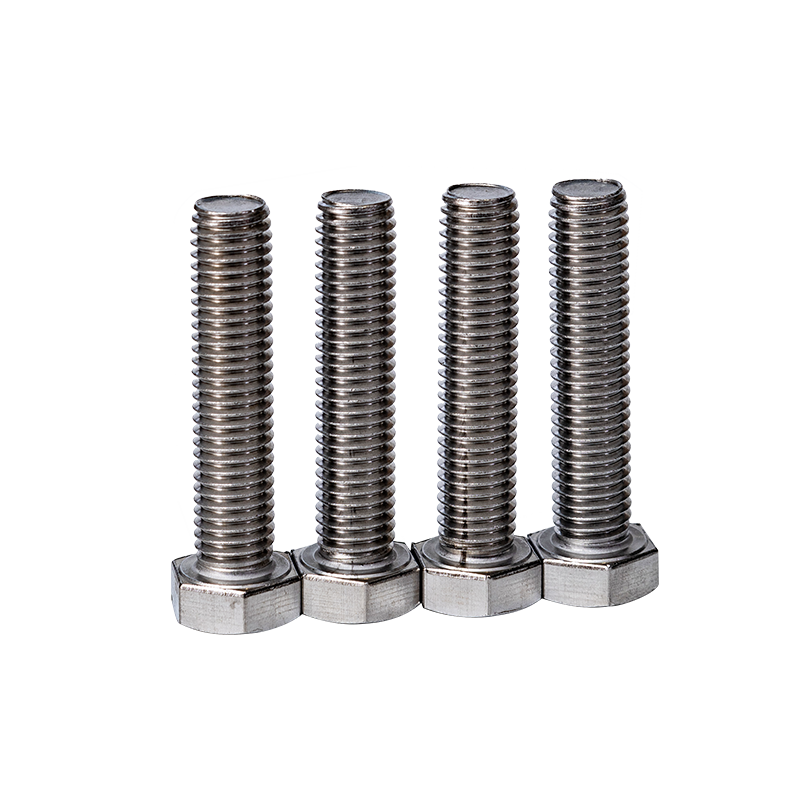
Stainless Steel Bolt Markings: A2 and A3 Series
Stainless steel bolts use a separate marking convention defined under ISO 3506. Rather than radial lines or two-digit class numbers, they are stamped with a letter-number combination that identifies both the steel group and the strength level. The most common markings are A2-70 and A2-80, where "A2" refers to austenitic 304-grade stainless steel, and the number (70 or 80) represents 1/10th of the minimum tensile strength in MPa — meaning A2-70 has a minimum tensile strength of 700 MPa and A2-80 reaches 800 MPa.
For marine or aggressive chemical environments, A4 designates 316-grade stainless steel. An A4-70 bolt provides the same 700 MPa tensile floor as A2-70 but with superior resistance to chloride-induced corrosion. The range of stainless steel hexagon head bolts in 304 and 316 grades covers both A2 and A4 material groups across standard metric dimensions.
One important note: stainless steel bolts are not magnetic, which makes them easy to distinguish from carbon steel bolts on-site — but they should never be substituted for high-strength structural grades like 10.9 or Grade 8 on the basis of corrosion resistance alone, since stainless grades typically carry lower tensile and yield values.
Bolt Grade Comparison Table: SAE vs Metric vs ASTM
Because the three systems were developed independently, direct equivalents are approximate rather than exact — differences in heat treatment, geometry, and testing protocols mean that a Grade 5 and a Class 8.8 bolt are not interchangeable despite similar tensile ratings. Use the table below as a starting reference, not a substitution guide.
| SAE Grade | ISO Metric Class | ASTM Standard | Min. Tensile Strength | Typical Use |
|---|---|---|---|---|
| Grade 2 | 4.6 / 4.8 | A307 Grade A | ~60,000–74,000 psi / 400 MPa | Light-duty, non-critical assemblies |
| Grade 5 | 8.8 | A325 | ~120,000 psi / 800 MPa | General machinery, structural steel |
| Grade 8 | 10.9 | A490 | ~150,000 psi / 1,040 MPa | High-stress, heavy-duty applications |
| — | 12.9 | — | 1,220 MPa | Critical mechanical, aerospace |
| A2-70 / A2-80 (SS) | A2-70 / A2-80 | F593 | 700–800 MPa | Corrosion-resistant, food/marine |
Choosing the Right Grade for Your Application
Grade selection comes down to three factors: load requirement, environment, and assembly method. Getting any one of them wrong increases the risk of joint failure, fastener fatigue, or accelerated corrosion.
For general commercial and light-duty assembly — furniture frames, HVAC brackets, non-structural enclosures — Grade 2 or Class 4.8 bolts are sufficient and cost-effective. Grade 5 / Class 8.8 covers the vast majority of general industrial machinery, automotive components, and structural connections where reliable clamping force and moderate vibration resistance are needed. Grade 8 / Class 10.9 is the right call for high-torque joints, heavy equipment, and any assembly that sees dynamic or cyclic loading. Class 12.9 is reserved for precision mechanical or aerospace applications where maximum preload is essential and bolt stretch must be tightly controlled.
In outdoor, coastal, or chemically aggressive environments, switching to stainless steel is often the better long-term investment even if the load demands are modest. An A2-70 or A4-70 bolt will outlast a zinc-plated Grade 5 by years in a marine setting. For hex socket drive applications in tight or recessed spaces, DIN 912 allen bolts for recessed-head socket applications offer strong clamping in a compact footprint.
Finally, always match the nut grade to the bolt grade. A Grade 8 bolt paired with a Grade 2 nut creates a weak point that defeats the purpose of specifying a high-strength fastener. For a complete selection of stainless fasteners across multiple grades and dimensions, the full range of stainless steel bolts covers standard metric sizes in both 304 and 316 material to match your specific application requirements.

 No. 2 Bridge, Chuangxin Road, Dainan Town, Xinghua City, Taizhou City, Jiangsu Province
  +86-17315333748(Wechat)
 +86-17315333748(Wechat/Whatsapp)

