


 русский
 Español
 عربى
عربى italiano
A single missing thread can halt an entire production line. In thin-sheet assembly — where drilling and tapping from both sides is either impossible or impractical — the riv nut was engineered to solve exactly that problem. Originally developed by BF Goodrich in the 1930s to attach rubber de-icing boots to aircraft wings, this deceptively simple fastener has since become standard hardware across automotive plants, electronics factories, and fabrication shops worldwide.
Whether you call it a riv nut, rivnut, blind rivet nut, or nutsert, the core function is the same: deliver a strong, reusable threaded connection from one side only. This guide walks through what riv nuts are, how they work, which type fits which job, and what to consider before you place an order.
Content
What Is a Riv Nut and How Does It Work
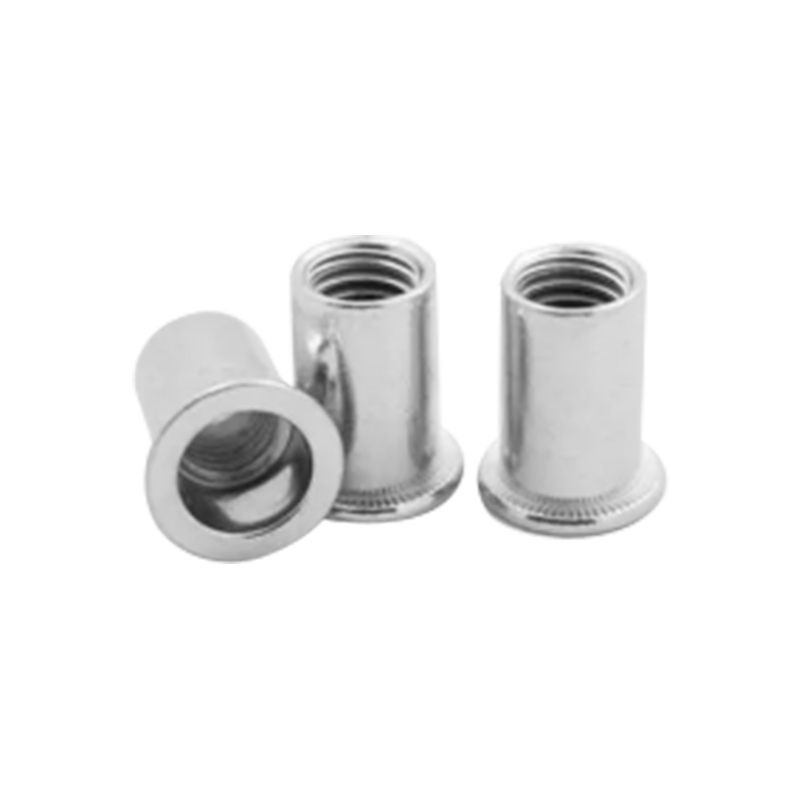
A riv nut is a one-piece, internally threaded tubular fastener that can be installed entirely from the front face of a workpiece — no access to the back side required. That single characteristic sets it apart from weld nuts, cage nuts, and conventional tapped holes, all of which demand either dual-side access or additional welding operations.
The installation sequence is straightforward. A pre-drilled hole is made in the parent material. The riv nut is inserted into that hole with the flange sitting flush against the surface. A setting tool — either manual or pneumatic — threads into the riv nut's bore and pulls the inner shank upward. This axial pulling force causes the unthreaded shank body to buckle outward, forming a locking "bulge" or collar on the blind side of the panel. Once set, the fastener is permanently locked in place, and a bolt or screw can be threaded in and out as many times as needed.
The result is a reusable, load-bearing thread embedded in material that is otherwise too thin or too hard to tap directly. Standard riv nuts handle sheet thicknesses ranging from under 1 mm up to roughly 6 mm depending on body length and grip range. For applications with variable material stacks, extended-range versions like the PLUSNUT® body style accommodate a much wider clamping range without changing hardware.
Browse the full range of rivet nut products to find the specification that matches your panel thickness and thread size.
Types of Riv Nuts: Which One Fits Your Application
Riv nuts are manufactured in several body and head configurations. The right choice depends on torque requirements, anti-rotation needs, space constraints, and whether the installation environment is exposed to moisture or pressure.
| Type | Key Feature | Best For |
|---|---|---|
| Round Body, Open End | Standard profile; allows bolt pass-through | General assembly, sheet metal panels |
| Round Body, Closed End | Sealed tip; prevents fluid ingress | Marine, outdoor, pressurized enclosures |
| Hex Body | Six-sided shank resists spin-out | High-torque bolted joints, soft materials |
| Knurled / Half-Hex Body | Serrated or partial hex for thin-wall panels | Thin sheet metal, plastics, low-profile constraints |
| Flat Head | Wide flange sits on panel surface | Standard surface-mount applications |
| Countersunk Head | Tapered head sits flush with panel face | Aerospace skins, decorative panels, sliding surfaces |
For most general industrial use, a round body flat-head open-end riv nut is the default starting point. If spin-out is a concern — common in plastics or soft aluminum — move to a hex body. If the joint will be exposed to water, coolant, or pneumatic pressure, select a closed-end variant. When flush appearance matters (as in visible automotive trim or aviation skins), the countersunk head eliminates any surface protrusion.
Common Materials and Coatings
Material selection for riv nuts follows the same logic as any structural fastener: match the fastener to both the parent material and the operating environment. Mismatched metals in wet conditions accelerate galvanic corrosion; under-specified tensile strength leads to thread strip-out under load.
- Carbon Steel (Zinc-Plated): The most economical option. Zinc electroplating provides moderate corrosion resistance. Suitable for indoor applications, dry environments, and general manufacturing where cost is a priority. Not recommended for marine or highly corrosive settings.
- Stainless Steel (A2 / A4): A2 (304) handles most industrial and light outdoor use. A4 (316) adds molybdenum for superior resistance to chlorides, making it the standard choice for marine hardware, food processing equipment, and chemical environments.
- Aluminum (5056 / 6061): Lightweight, naturally corrosion-resistant, and non-magnetic. Preferred in aerospace and electronics where weight is a design variable. Aluminum riv nuts are typically cold-formed, which preserves material strength without heat distortion. Tensile strength is lower than steel, so verify thread load requirements before substituting.
Beyond base material, additional coatings — hot-dip galvanizing, Dacromet, or mechanical zinc — can extend service life in aggressive outdoor or industrial environments. Always confirm that the coating is compatible with the mating bolt material and any chemical exposure the joint will face.
Where Riv Nuts Are Used: Industry Applications
The blind installation advantage makes riv nuts the fastener of choice anywhere sheet assemblies meet complex geometry or restricted access. Below are the industries that rely on them most heavily and why.
- Automotive Manufacturing: Body panels, door frames, seat track brackets, and battery enclosures in electric vehicles all use riv nuts to create threaded anchors in formed sheet metal without distorting stamped geometry. High-volume lines use pneumatic or battery-powered setting tools that install a riv nut in under two seconds.
- Aerospace and Defense: Aircraft skins, inspection access covers, static discharger mounts, and interior panel brackets depend on riv nuts. This application is governed by National Aerospace Standards NAS 1329 (flat head) and NAS 1330 (countersunk head), which specify tight dimensional tolerances, ultimate thread strength tests, and qualified aluminum alloys (5056, 6053, or 6061 per ASTM/AMS material standards).
- Electronics and Enclosures: Server rack chassis, switch gear panels, and consumer electronics housings use riv nuts to provide removable mounting points in thin-gauge steel or aluminum enclosures. The closed-end version also provides EMI sealing in sensitive electronic assemblies.
- Furniture and Construction: Steel furniture, display fixtures, and modular construction panels use riv nuts to allow repeated disassembly and reassembly without degrading the thread. Unlike tapped sheet metal, riv nut threads do not wear out after several assembly cycles.
- Renewable Energy Equipment: Solar mounting frames, wind turbine nacelle panels, and battery storage enclosures require corrosion-resistant threaded connections in thin structural sections. Stainless steel riv nuts are standard in these outdoor service environments.
Riv Nut vs. Weld Nut: Key Differences
Weld nuts and riv nuts both add a threaded insert to a parent structure, but the installation method drives significant differences in cost, quality, and application flexibility.
Welding introduces heat into the parent material. On thin sheet steel, that heat distorts the panel surface, creates weld spatter that requires cleaning, and produces fumes that require extraction systems and operator protection. On aluminum, magnesium, or pre-coated materials, welding becomes either technically difficult or structurally damaging. Riv nuts avoid all of this: installation is mechanical, cold, and clean.
From a production standpoint, riv nut installation requires no post-weld grinding or spatter removal. Quality checks are faster — a go/no-go thread gauge and a pull-out test verify the installation immediately. On automated lines, riv nuts integrate cleanly into robotic assembly cells without the ventilation and fire-safety infrastructure welding requires.
The tradeoff is load capacity. A large weld nut with a full weld bead can transmit higher shear and tensile loads than a riv nut of equivalent thread size. In structural joints where the fastener sees both high axial pull-out and side loads simultaneously, weld nuts may still be the engineering choice. For the vast majority of panel and enclosure assembly tasks, however, riv nuts match or exceed practical load requirements while offering clear process advantages.
Compare welding nuts as an alternative fastening solution and hex nuts for high-torque applications to find the right fit for your specific joint design.
How to Choose the Right Riv Nut
Selecting the correct riv nut involves four variables: thread specification, grip range, body style, and material. Get all four right, and the installation is fast, strong, and reliable. Miss one, and you face spin-out, incomplete bulge formation, or premature thread failure.
- Thread Size and Standard: Match the riv nut thread to the mating bolt. For international supply chains, confirm whether the project uses ISO metric (M3–M16 is the common commercial range), imperial UNC/UNF, or aerospace NAS specifications. ISO and DIN standards govern dimensional tolerances and thread strength for industrial use. Aerospace applications typically require NAS 1329 or NAS 1330 compliance — standards that mandate specific material grades, dimensional tolerances, and ultimate thread strength testing for aviation-grade performance.
- Grip Range: Measure the panel thickness (or combined stack thickness if fastening through multiple layers). The riv nut's grip range must include that measurement. Installing a riv nut in material thinner than its minimum grip prevents full bulge formation; material thicker than its maximum grip prevents the body from collapsing at all.
- Body Style: Round body for smooth holes and moderate torque. Hex body when spin-out is a risk. Knurled body for thin-wall panels or plastic substrates. PLUS-body when the material thickness varies across the production run.
- Material: Carbon steel for cost-sensitive dry indoor applications. Stainless steel for corrosive or washdown environments. Aluminum where weight is a constraint. Confirm compatibility with the parent material to avoid galvanic corrosion risk.
When specifying in volume, request test data on pull-out strength and thread proof load from your supplier — these figures vary between manufacturers and are directly relevant to joint safety calculations. Explore the complete fastener product catalog to compare available specifications and request a quote for your project.

 No. 2 Bridge, Chuangxin Road, Dainan Town, Xinghua City, Taizhou City, Jiangsu Province
  +86-17315333748(Wechat)
 +86-17315333748(Wechat/Whatsapp)

