


 русский
 Español
 عربى
عربى italiano
Content
The Functional Advantage of Integrated Flanges
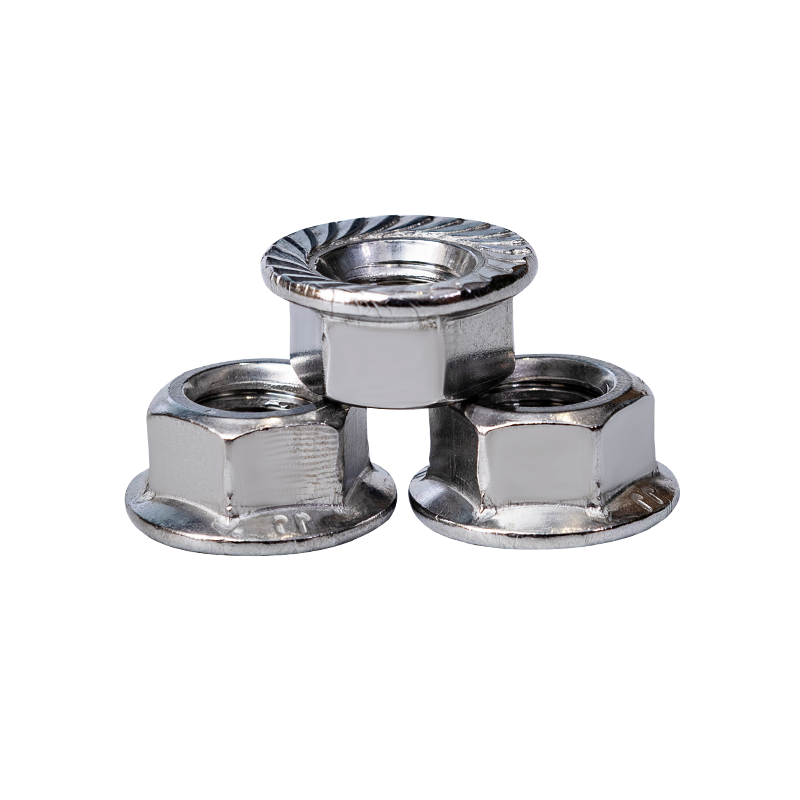
Stainless steel hexagon flange nuts eliminate the need for separate washers by integrating a wide bearing surface directly into the nut design. This integration distributes clamping force over a larger area, reducing pressure on soft materials and preventing loosening caused by vibration. The result is a faster assembly process and a more reliable connection in dynamic environments.
Unlike standard hex nuts that require a flat washer to protect the substrate and distribute load, flange nuts combine these functions into a single component. This reduces part count, inventory complexity, and assembly time. In automated manufacturing, using flange nuts can reduce assembly time by up to 30% because there is no second component to handle or position.
Load Distribution Mechanics
The flange acts as a built-in washer, increasing the contact area between the nut and the workpiece. This is critical when fastening into soft materials like aluminum, plastic, or wood, where standard nuts might dig in or cause deformation. The wider bearing surface lowers the bearing stress, ensuring the joint remains secure without damaging the underlying material.
Material Grades and Corrosion Resistance
Not all stainless steel is created equal. Selecting the correct grade is essential for balancing cost, strength, and environmental resistance. Austenitic grades like 304 and 316 are the most common choices for flange nuts, offering excellent corrosion resistance and good mechanical properties for general industrial use.
Comparing Common Stainless Grades
| Grade | Corrosion Resistance | Strength (MPa) | Best Application |
|---|---|---|---|
| 304 (A2) | Good (General) | 700-800 | Indoor machinery, food processing |
| 316 (A4) | Excellent (Marine/Chemical) | 700-800 | Marine environments, chemical plants |
| 410 | Moderate | 900+ | High-stress, low-corrosion areas |
The Role of Molybdenum in Grade 316
Grade 316 stainless steel contains 2-3% molybdenum, which significantly enhances its resistance to pitting and crevice corrosion in chloride-rich environments. In coastal or de-icing salt applications, 316 flange nuts can last 3-5 times longer than 304 equivalents before showing signs of rust. For indoor or dry outdoor applications, 304 provides sufficient protection at a lower cost.
Serrated vs. Non-Serrated Flange Designs
The underside of the flange determines how well the nut resists rotation under vibration. Serrated flange nuts feature radial teeth that bite into the mating surface, providing superior locking action without the need for additional lock washers or thread-locking compounds.
When to Use Serrated Flanges
- High Vibration Environments: Automotive engines, heavy machinery, and vibrating screens benefit from the mechanical grip of serrations.
- Unpainted Metal Surfaces: Serrations require direct metal-to-metal contact to function effectively. They are ideal for bare steel or aluminum joints.
- Preventing Loosening: The teeth act as a one-way ratchet, resisting counter-clockwise rotation that causes loosening.
Limitations of Serrated Designs
Serrated nuts should not be used on soft materials like plastic or wood, as the teeth will damage the surface. They are also unsuitable for painted or coated surfaces, as the serrations will scratch through the protective layer, potentially creating a site for corrosion to begin. In these cases, non-serrated (plain) flange nuts are the preferred choice to maintain surface integrity while still distributing load.
Installation Best Practices and Torque Considerations
Proper installation ensures the flange nut performs as intended. Because the flange increases the bearing area, the friction coefficient between the nut and the workpiece changes, which affects torque requirements. Always consult manufacturer torque specifications, as standard charts for hex nuts may not apply directly to flange nuts.
Torque and Friction Dynamics
The larger contact area of a flange nut creates more friction during tightening. This means that for a given torque value, the actual clamp load generated may be slightly lower than with a standard nut and washer combination. To compensate, ensure threads are clean and lubricated if permitted by the application. Using a torque wrench is critical to avoid under-tightening, which leads to loosening, or over-tightening, which can strip threads or deform the flange.
Common Installation Mistakes
- Stacking Washers: Never add a flat washer under a flange nut. It negates the design benefit and can lead to uneven loading.
- Ignoring Surface Condition: Ensure the mating surface is flat and clean. Debris under the flange can cause uneven clamping and joint failure.
- Mismatched Bolts: Use bolts with matching strength grades. A high-strength stainless nut on a weak zinc-plated bolt will not improve joint integrity.
For critical applications, consider using a thread-locking adhesive in conjunction with non-serrated flange nuts if vibration is a concern but surface damage must be avoided. This hybrid approach provides both load distribution and rotational security.
Industry Applications and Selection Criteria
Stainless steel hexagon flange nuts are versatile components found across numerous industries. Their selection depends on specific environmental and mechanical demands. Understanding the primary stressors in your application—whether chemical, thermal, or vibrational—guides the correct choice of grade and design.
Key Industry Uses
- Automotive: Used in exhaust systems and engine mounts where vibration resistance and heat tolerance are critical. Grade 304 or 410 is common.
- Food and Beverage: Hygienic design requirements favor smooth, non-serrated flange nuts made from 316 stainless steel for easy cleaning and corrosion resistance against acidic foods.
- Marine and Offshore: Constant exposure to saltwater mandates 316 stainless steel with non-serrated flanges to prevent galvanic corrosion and surface damage to coated hulls.
- Electronics Enclosures: Small M3 and M4 flange nuts provide secure mounting for panels without requiring extra space for washers, aiding in miniaturization.
Cost-Benefit Analysis
While stainless steel flange nuts have a higher unit cost than standard carbon steel nuts, the total cost of ownership is often lower. The elimination of separate washers reduces inventory items, and the corrosion resistance minimizes replacement frequency. In corrosive environments, the lifecycle cost of stainless flange nuts can be 40-60% lower than plated carbon steel alternatives due to reduced maintenance and downtime.

 No. 2 Bridge, Chuangxin Road, Dainan Town, Xinghua City, Taizhou City, Jiangsu Province
  +86-17315333748(Wechat)
 +86-17315333748(Wechat/Whatsapp)

