


 русский
 Español
 عربى
عربى italiano
Content
- 1 Why Bolt Head Markings Exist
- 2 SAE Grade Markings: Reading Radial Lines on Inch-Series Bolts
- 3 ISO Metric Property Class: Decoding the Two-Number System
- 4 ASTM Structural Bolt Markings: Letters, Numbers, and Heavy-Hex Standards
- 5 Stainless Steel Bolt Markings: A2, A4, and the Number After the Dash
- 6 Manufacturer Identification Marks: Traceability Built Into Every Head
- 7 Why Reading Bolt Markings Correctly Matters in Practice
Why Bolt Head Markings Exist
Pick up any structural bolt and look at the top of its head. You will find a combination of numbers, letters, radial lines, or all three stamped into the metal. These are not decorative, and they are not arbitrary — they are a standardized language developed over decades to answer a question that matters enormously in every engineering application: exactly how strong is this fastener, who made it, and to which standard was it manufactured?
The need for bolt head markings became acute as industrial manufacturing scaled up through the twentieth century. When a single assembly might contain thousands of bolts sourced from dozens of suppliers, visually identical fasteners with dramatically different mechanical properties could — and did — find their way into the same joint. A bolt that appears identical to a Grade 8 but is actually a Grade 2 carries less than two-thirds of the tensile load capacity. In a structural or safety-critical application, the consequences of that substitution can be catastrophic.
Bolt head markings solve this problem by making strength grade, material class, and manufacturer identity permanently visible on the fastener itself — independent of packaging, labeling, or documentation that can be separated from the hardware during handling. International standards bodies including SAE, ISO, ASTM, and DIN have each developed marking systems for their respective fastener standards, and understanding the differences between these systems is essential for anyone who specifies, purchases, inspects, or installs bolted connections.
SAE Grade Markings: Reading Radial Lines on Inch-Series Bolts
The SAE J429 standard, published by the Society of Automotive Engineers, governs the mechanical and material requirements for inch-series bolts, screws, studs, and U-bolts up to 1½ inches in diameter. Under this system, bolt grade is indicated by radial lines stamped on the head — straight lines radiating outward from the center like spokes, positioned symmetrically around the head.
The decoding rule is straightforward: the grade equals the number of radial lines plus two. A bolt with no radial lines is Grade 2. A bolt with three radial lines is Grade 5. A bolt with six radial lines is Grade 8. Grade 2 represents the lowest commonly available strength level — low carbon steel, no heat treatment required, suitable for general non-critical fastening. Grade 5 is a medium-strength fastener produced from medium carbon steel that has been heat-treated by quenching and tempering; it is the standard choice for most automotive and general mechanical applications. Grade 8 is a high-strength fastener, also quenched and tempered, required for heavy-duty structural loads, high-vibration environments, and applications where joint preload must be precisely controlled.
The minimum tensile strengths associated with these grades give the radial line system its practical meaning. For bolts in the ¼ to 1 inch diameter range, Grade 2 carries a minimum tensile strength of 74,000 psi (510 MPa), Grade 5 reaches 120,000 psi (827 MPa), and Grade 8 achieves 150,000 psi (1,034 MPa). These are not interchangeable values — substituting a Grade 2 for a Grade 8 in a designed joint reduces the bolt's tensile capacity by approximately 50%, with proportional reductions in clamping force and fatigue resistance.
One detail that consistently surprises engineers encountering the SAE system for the first time: Grade 2 bolts carry no radial line marking at all. The absence of lines is itself the grade indicator. This means that an unmarked bolt is not a bolt of unknown grade — within the SAE J429 system, it is specifically a Grade 2, the lowest defined strength class. However, an unmarked bolt from outside the SAE system tells you nothing about its strength, which is precisely why source verification and marking confirmation matter during procurement.
ISO Metric Property Class: Decoding the Two-Number System
Metric bolts manufactured to ISO 898-1 use a fundamentally different marking approach — numeric codes stamped directly onto the bolt head rather than radial lines. These codes, called property classes, consist of two numbers separated by a dot, such as 8.8, 10.9, or 12.9. The system is more analytically transparent than the SAE radial line system because the numbers themselves encode the bolt's mechanical properties directly.
The first number, when multiplied by 100, gives the approximate minimum tensile strength of the bolt in megapascals. A bolt marked 8.8 has a minimum tensile strength of approximately 800 MPa. A bolt marked 10.9 has a minimum tensile strength of approximately 1,000 MPa. A bolt marked 12.9 has a minimum tensile strength of approximately 1,200 MPa — making it the highest-strength grade in common industrial use, comparable to the most demanding aerospace and motorsport fastening applications.
The second number, when multiplied by 10, gives the yield strength as a percentage of the minimum tensile strength. For an 8.8 bolt, the second digit (8) indicates that the yield strength is 80% of the tensile strength: 800 × 0.80 = 640 MPa minimum yield strength. For a 10.9 bolt, the yield strength is 90% of tensile: 1,000 × 0.90 = 900 MPa. This ratio — yield to tensile — is a critical design parameter because it defines how much of the bolt's tensile capacity can be used as preload before the fastener begins to permanently deform.
The most common metric property classes encountered in industrial practice are 4.6 and 4.8 for general-purpose low-strength applications, 8.8 for standard structural and mechanical use, 10.9 for high-strength applications where space or weight constraints limit bolt diameter, and 12.9 for the most demanding load conditions. Lower classes such as 4.6 and 4.8 are frequently not marked on the bolt head — similar to the Grade 2 convention in the SAE system — because they represent basic strength levels where a marking omission does not create the same risk of dangerous substitution as it would at higher strength levels.
ASTM Structural Bolt Markings: Letters, Numbers, and Heavy-Hex Standards
The American Society for Testing and Materials (ASTM) publishes a separate series of fastener specifications used primarily in structural steel construction, infrastructure, and heavy industrial applications. Unlike the SAE system, ASTM bolt head markings use alphanumeric codes that directly reference the specification standard rather than encoding mechanical properties through lines or calculated numbers.
ASTM A325 bolts — one of the two most widely specified structural bolt types in North American construction — are marked with the letters "A325" on the bolt head, along with the manufacturer's identification symbol. They are medium-strength structural bolts made from medium carbon steel, heat-treated to a minimum tensile strength of 120,000 psi for diameters up to 1 inch. They are manufactured as heavy hex bolts — with a larger head and body dimensions than standard hex bolts — specifically because structural connections require both the higher bearing area of the heavy hex head and the ability to apply large installation torques without head rounding.
ASTM A490 bolts represent the high-strength structural category, marked "A490" on the head. They are heat-treated alloy steel fasteners with a minimum tensile strength of 150,000 psi, used in connections where the joint geometry or load magnitude requires a higher-strength fastener than A325 provides. Both A325 and A490 are subject to proof load testing requirements, installation verification procedures under AISC and RCSC specifications, and restrictions on reuse — A490 bolts must not be reused after tensioning, and both types require careful storage and handling to prevent strength reduction through hydrogen embrittlement in galvanized versions.
ASTM F3125 is the current unified standard that now encompasses several previously separate structural bolt grades including A325 and A490 as Grade A325 and Grade A490 within a consolidated framework. Regardless of the specific standard revision in effect, the marking principle remains consistent: the ASTM designation appears on the bolt head, providing direct cross-reference to the published specification and its associated mechanical property requirements.
Stainless Steel Bolt Markings: A2, A4, and the Number After the Dash
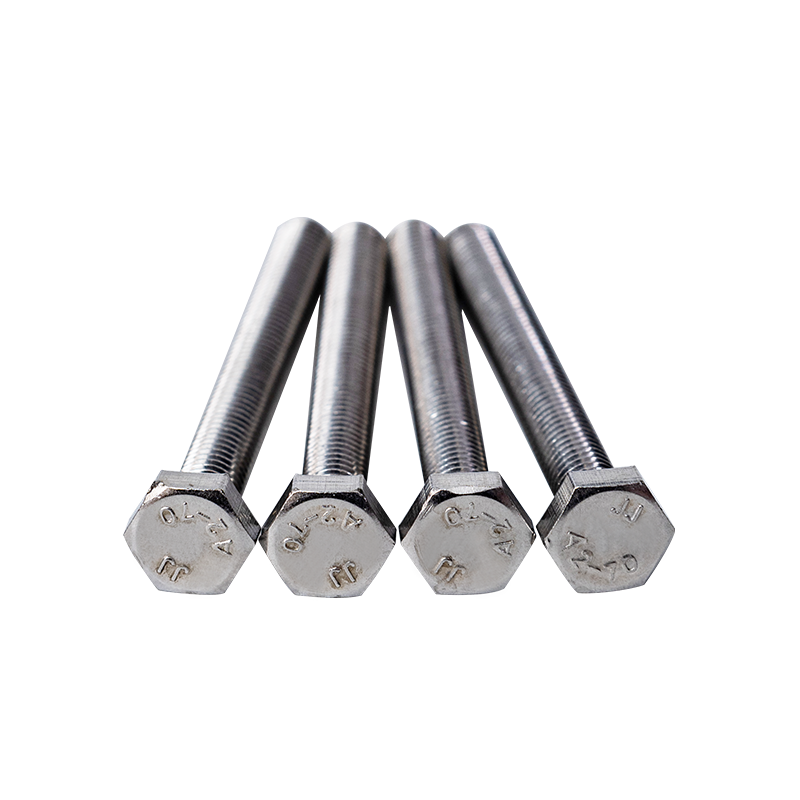
Stainless steel bolts follow a separate marking convention defined by ISO 3506, which uses a two-part code combining a material designation with a strength level number. The material designation comes first — A2 for austenitic 304 stainless steel, A4 for austenitic 316 stainless steel — followed by a dash and a two-digit number representing the tensile strength class.
In the designation A2-70, the "A2" identifies the material as 304 stainless steel, and the "70" indicates a minimum tensile strength of 700 MPa. In A4-70, the "A4" identifies 316 stainless steel at the same 700 MPa tensile strength level. The most commonly encountered grades in industrial and marine applications are A2-70 and A4-70, though A2-80 and A4-80 are available for applications requiring higher clamping forces from the same stainless steel material.
The practical distinction between A2 and A4 is primarily corrosion resistance rather than mechanical strength. Both 304 and 316 stainless steels form a passive chromium oxide layer that provides excellent resistance to atmospheric corrosion and many chemical environments. However, 316 stainless — the A4 designation — incorporates approximately 2–3% molybdenum in its alloy composition, which significantly improves resistance to chloride-induced pitting corrosion. For applications in marine environments, coastal installations, chemical processing, or anywhere chloride exposure is a design consideration, A4-grade fasteners are the correct specification. For a detailed comparison of material grades and their performance characteristics, our guide to stainless steel hex bolts covers the full selection criteria in depth.
An important caveat for engineers transitioning between carbon steel and stainless specifications: stainless steel bolts are not as strong as high-grade carbon steel bolts of the same dimensions. An A4-70 stainless bolt has a minimum tensile strength of 700 MPa — less than an SAE Grade 8 (1,034 MPa) or ISO 10.9 (1,000 MPa). Where the design requires both corrosion resistance and high strength, this trade-off must be explicitly managed through joint design, bolt size selection, or specification of duplex stainless grades that offer improved strength alongside corrosion performance.
Manufacturer Identification Marks: Traceability Built Into Every Head
Alongside grade and property class markings, virtually all fastener standards require the manufacturer to stamp a unique identification symbol on the bolt head. This symbol — typically one to three characters, which may be letters, numbers, or a proprietary logo — serves a function entirely separate from strength identification: it enables complete traceability from the installed fastener back to its production source.
The traceability function matters in several practical scenarios. When a fastener fails in service, the manufacturer mark allows the investigation to identify the production batch, retrieve the associated material certificates and test records, and determine whether the failure resulted from a manufacturing defect, a specification error, or an installation problem. For safety-critical industries — structural construction, automotive, aerospace, pressure equipment — this audit trail is not optional; it is a regulatory requirement that manufacturers must satisfy and that procurement teams must verify is present on delivered hardware.
Counterfeit fasteners — products that carry grade markings they have not earned through compliant manufacturing and testing — are a genuine and persistent problem in global supply chains. Research by fastener industry associations has consistently identified high-strength grades, particularly metric 10.9 and 12.9 and SAE Grade 8, as the most commonly counterfeited, because the price premium of these grades creates the economic incentive for substitution. Manufacturer marks that can be cross-referenced against known supplier lists and accompanied by mill test certificates and third-party inspection reports are the primary defense against counterfeit fastener risk in procurement.
For this reason, reputable fastener manufacturers maintain comprehensive documentation systems that link every production batch to its material chemistry, mechanical test results, dimensional inspection records, and heat treatment parameters. When a customer specifies a bolt to a particular grade and requests certification documentation, that documentation package — traceable through the manufacturer mark to the production record — is what gives the grade marking on the bolt head its legal and engineering meaning.
Why Reading Bolt Markings Correctly Matters in Practice
The most common practical error in bolt marking identification is not misreading a mark — it is failing to look for one, or accepting an unmarked fastener without investigating why the mark is absent. In high-volume assembly operations, bolts from different production batches or suppliers are frequently mixed in bins or trays. Visual similarity between grades is nearly perfect: a Grade 5 and a Grade 8 hex bolt of the same diameter and length are externally indistinguishable except for the head markings. An installation technician who does not check the head markings before applying torque has no way of knowing which grade is in hand.
The second common error is cross-system substitution — replacing a metric bolt with an inch-series fastener of apparently similar dimensions, or vice versa, without recognizing that thread geometry, strength certification, and torque specifications differ between systems. SAE Grade 5 and ISO 8.8 are often described as broadly comparable in strength, but they are not interchangeable: the thread forms, pitch tolerances, and proof load values differ, and substitution without engineering review violates the design intent of the joint.
For procurement teams and quality managers, the practical guidance that flows from understanding bolt head markings is direct. Specify the exact grade, standard, and manufacturer documentation requirements in purchase orders. Inspect incoming fasteners for correct head markings before acceptance. Maintain segregated storage by grade with clear labeling. Require mill test certificates and third-party test reports for safety-critical grades. Never install a fastener whose head markings are absent, ambiguous, or inconsistent with the purchase specification without resolving the discrepancy through the supplier.
The numbers and lines stamped into a bolt head represent the cumulative output of manufacturing standards, material science, and quality systems — a compact encoding of information that took decades of industrial experience to develop. Reading them correctly is one of the simplest and most consequential quality checks in any fastened assembly, requiring nothing more than knowledge of the marking system and a moment of attention before the wrench is applied.

 No. 2 Bridge, Chuangxin Road, Dainan Town, Xinghua City, Taizhou City, Jiangsu Province
  +86-17315333748(Wechat)
 +86-17315333748(Wechat/Whatsapp)

