


 русский
 Español
 عربى
عربى italiano
Check the head of a stainless steel bolt and you will usually find a code such as A2-70 or A4-80. That code is not decorative; it identifies the alloy family and the minimum mechanical strength the fastener must meet. For anyone specifying, purchasing, or inspecting stainless fasteners, a stainless steel bolt grades chart is a practical tool: it explains why one bolt suits a coastal handrail while another does not, and why a cheaper bolt with identical threads can be the wrong choice in a load-bearing joint.
A stainless steel bolt grades chart rests on two independent pieces of information: what the bolt is made from, the alloy family, and how strong the finished bolt is, the property class. Neither alone is sufficient. An A2-50 bolt and an A2-80 bolt can share the same 304 base material, yet their minimum tensile strengths differ by 300 MPa. Choosing by diameter, thread pitch, or price alone is how preventable fastener failures begin.
Content
- 1 What a Stainless Steel Bolt Grades Chart Covers
- 2 Stainless Steel Bolt Grades Chart: Strength and Corrosion Data at a Glance
- 3 How to Read Head Markings on Stainless Steel Bolts
- 4 304 vs 316: Which Stainless Bolt Grade Should You Specify?
- 5 Less Common Stainless Grades in the Chart
- 6 Practical Checks When Buying Stainless Steel Bolts
What a Stainless Steel Bolt Grades Chart Covers
Most grade charts for stainless fasteners follow ISO 3506. The designation combines an alloy code, A1, A2, A3, A4, or A5, with a property class, 50, 70, or 80. A bolt stamped A2-70 therefore communicates two things at once: the material belongs to the A2 family, broadly equivalent to 304, and the bolt reaches a minimum tensile strength of 700 MPa.
Alloy Families on the Chart
The austenitic families dominate stainless fastener production. The 18-8 group, which includes 302, 303, and 304, is marked A2. The molybdenum-bearing group, which includes 316 and 316L, is marked A4. A3 and A5 cover stabilized grades for elevated-temperature service, and A1 covers free-machining grades such as 303. Grade 201, which appears often in low-cost imports, has no ISO fastener designation, one reason why specifiers treat it as a substitution risk.
Property Classes in Practice
Property classes state minimum tensile strength: 50 means 500 MPa, 70 means 700 MPa, and 80 means 800 MPa. Class 50 fasteners are annealed and soft, suitable for applications that require a degree of cold forming. Class 70 is the workhorse specification for cold-formed bolts and screws. Class 80 is the strongest rating commonly available for austenitic stainless and is achieved through controlled cold working. Because yield strength follows from property class, two A4-80 bolts from separate batches should, within tolerance, behave identically under proof load.
Stainless Steel Bolt Grades Chart: Strength and Corrosion Data at a Glance
The chart below summarizes common designations, typical material equivalents, and minimum mechanical values. The values in the table are minimums published in the ISO standards; a reliable supplier should provide batch test certificates on request.
| Designation | Common material | Property class | Min tensile (MPa) | Min yield (MPa) | Typical use |
|---|---|---|---|---|---|
| A1-50 | 303 / 303Se | 50 | 500 | 210 | Machined parts, light indoor fastening |
| A2-50 | 304 / 18-8 | 50 | 500 | 210 | Non-structural assemblies, ductwork |
| A2-70 | 304 / 18-8 | 70 | 700 | 450 | General machinery, outdoor structures |
| A2-80 | 304 / 302 | 80 | 800 | 600 | High-strength joints where 304 is sufficient |
| A4-70 | 316 / 316L | 70 | 700 | 450 | Marine hardware, chemical plant, coastal fittings |
| A4-80 | 316 / 316L | 80 | 800 | 600 | Offshore structures, chlorinated environments |
| A5-80 | 316Ti / 1.4571 | 80 | 800 | 600 | Elevated-temperature and high-corrosion service |
Read the chart in pairs: alloy letter first, property class second. A2-70 and A4-80 differ on both dimensions. Calling a fastener simply stainless ignores the gap between a 500 MPa annealed bolt and an 800 MPa hardened bolt, which is exactly the distinction a grade chart makes visible.
How to Read Head Markings on Stainless Steel Bolts
Carbon steel bolts use radial lines on the head; stainless steel bolts carry the ISO designation directly. A head stamped A4-80 means 316-family material at 800 MPa minimum tensile strength. A head stamped A2-70 means 304-family material at 700 MPa. Some manufacturers add numeric alloys such as 304 or 316, and a completely blank head is a warning sign rather than a normal variation.
Head markings align with the grade chart: find the designation, then check tensile and yield values. When markings are unclear, the only reliable verification is a material certificate from the manufacturer. Magnetism cannot separate 304 from 316; austenitic grades are generally non-magnetic, but cold working induces slight magnetism, and 201 behaves differently again, so a magnet test is only a first filter. For a deeper look at how properties map to applications, a complete guide to stainless steel hex bolts covers the subject in more detail.
304 vs 316: Which Stainless Bolt Grade Should You Specify?
In most architectural and industrial settings, A2 (304) is the default. It resists atmospheric corrosion, fresh water, steam, and many organic chemicals, and it is the most economical stainless fastener grade. A4 (316) adds molybdenum, which improves resistance to chlorides in coastal air, de-icing salts, washdown chemicals, and swimming pool atmospheres. The practical difference between 304 and 316 stainless hex bolts goes well beyond price.
Choose 304 for interior machinery, furniture, light outdoor equipment, and standard structural connections. Choose 316 for wet coastal exposure, marine atmosphere, food processing washdowns, and chemical environments. For continuous seawater immersion, even 316 has limits, and higher alloys or protective systems may be required.
When the specification settles on 304 material, one standard option is the SS304 hexagon head bolt manufactured to DIN933. Where chlorides are present, the SS316 hexagon head bolt in the same DIN933 form adds the corrosion margin without changing thread or wrenching geometry.
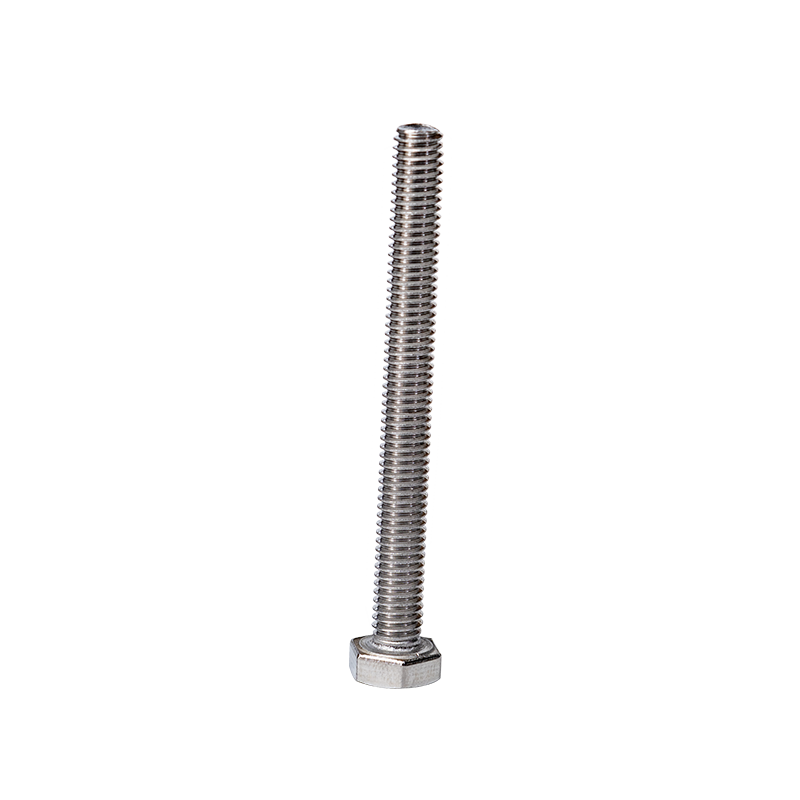 Stainless Steel 316 DIN933 M12 Hexagon Head Bolts Suppliers, Custom Company - JiJiangsu Jiajie is China Custom SS316 DIN933 M12 Hexagon Head Bolts Suppliers and Company, The M12 thread diameter ensures a secure fit an...View Product →
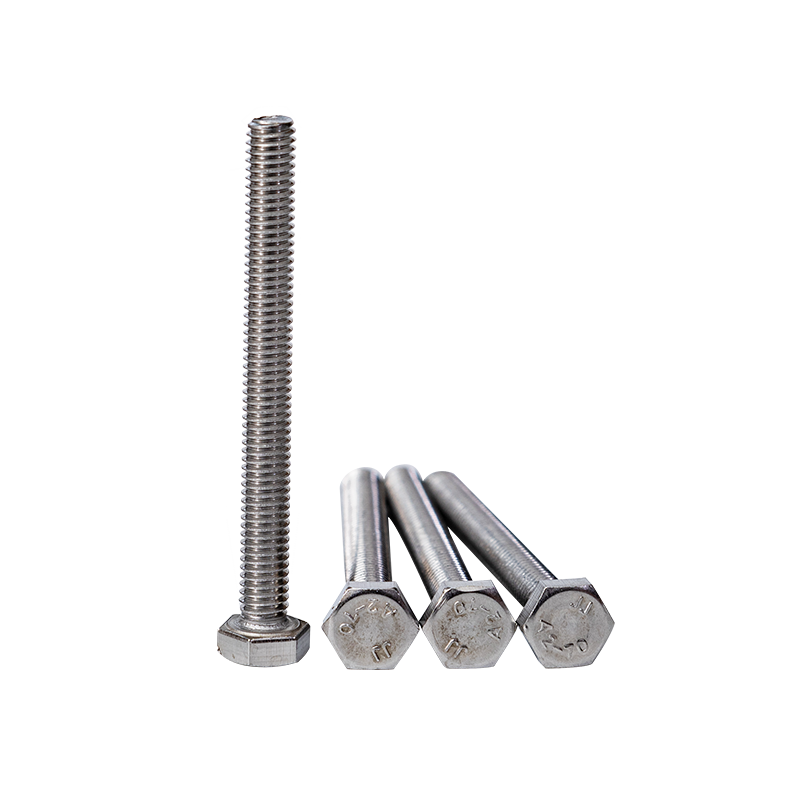 Stainless Steel 304 DIN933 M12 Hexagon Head Bolts Suppliers, Custom Company - JiJiangsu Jiajie is China Custom SS304 DIN933 M12 Hexagon Head Bolts Suppliers and Company, The M12 thread diameter ensures a secure fit an...View Product →
Less Common Stainless Grades in the Chart
Grade 201 appears frequently in budget fasteners. It is an austenitic stainless with reduced nickel content; it costs less, but its corrosion resistance and mechanical consistency are lower. Because 201 carries no ISO 3506 designation, its presence is difficult to verify from head markings alone, which makes it the most common hidden substitution in stainless bolt supply.
Grade 303 (A1) contains added sulfur for machinability. It suits turned components but corrodes faster than 304 and should not be used for structural bolts. Ferritic grade 430 has modest corrosion resistance and low strength, so it is rarely made into load-bearing bolts. When chloride stress corrosion is a genuine risk and higher strength is needed, duplex stainless such as 1.4462 can be specified, although it is less common in standard stock.
Practical Checks When Buying Stainless Steel Bolts
A grade chart helps with specification; verification belongs to the purchasing process. Check head markings on a sample from every batch, not only on the first delivery. Request a material test certificate for larger orders and confirm the referenced standard, whether ISO 3506 for material or DIN 933, DIN 931, GB 5783, or another standard for dimensions. Confirm the property class as well as the alloy, because A2-50 and A2-80 are completely different products despite sharing a material family.
Where high clamping force is needed in a compact assembly, a socket head is the conventional answer, and the DIN912 stainless steel socket head cap screw is one of the most requested forms in this category. Finally, correct grade selection does not end with the alloy: preventing stainless steel hex bolts from rusting in wet environments depends on clean surfaces, avoiding galvanic contact with dissimilar metals, and matching nuts and washers to the same material class.
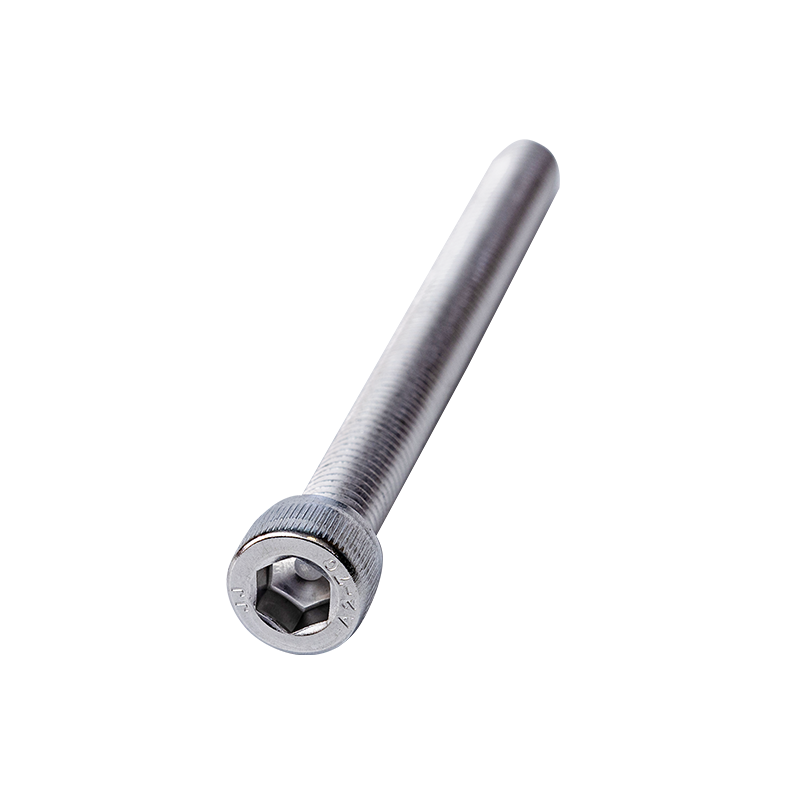 Stainless Steel 304 DIN912 M10 Allen Bolts Suppliers, Custom Company - Jiangsu JJiangsu Jiajie is China Custom SS304 DIN912 M10 Allen Bolts Suppliers and Company, The SS304 DIN912 Allen Bolts M10 are indispensable in ...View Product →
The takeaway is simple: a stainless steel bolt grades chart links the alloy that resists corrosion, the strength class that carries the load, and the head marking that you can verify before installation. Specifying with the chart, verifying by the marking, and confirming with a test certificate is the shortest route to a stainless connection that performs as designed.

 No. 2 Bridge, Chuangxin Road, Dainan Town, Xinghua City, Taizhou City, Jiangsu Province
  +86-17315333748(Wechat)
 +86-17315333748(Wechat/Whatsapp)

